

Traditional office leases still look tidy on a spreadsheet until the real costs arrive: fit-out overruns, specialist compliance requirements, a patchwork of vendors, and a lease term that outlasts the market cycle you are actually operating in.
For an established legal practice, the risk is not only financial. It is operational. When a matter escalates, a key hire joins, or a client requests an urgent meeting, the office should support the work rather than become the work.
Our premium serviced offices in Raffles Quay can change that equation.
Instead of tying capital up in a space you may outgrow, you secure a client-ready base with predictable outgoings, closed-door privacy, and the professional image expected of a serious firm operating near the courts.
In this guide, we outline 10 benefits of running law firm in serviced office.
1. Lower Total Cost Of Ownership (TCO) Versus A Traditional Lease
For a law firm, Total Cost of Ownership (TCO) includes everything that keeps the practice functioning: fit-out, furniture, networking, security controls, maintenance, cleaning, utilities, and the internal time spent coordinating it all. What looks like a lower rent can become a higher operational burden once the hidden line items surface.
A serviced office typically consolidates these moving parts into one accountable monthly fee. In practice, that changes how we plan, how we manage risk, and how confidently we can take on growth.
Launching a law firm in a raffles quay serviced office can be a strategic move—especially when flexibility, location, and client access matter.
For legal professionals, the environment must balance confidentiality with collaboration, professionalism with cost efficiency.
CoWorkSpace offers the infrastructure and industry-aligned support to make this possible. Here's how to get started.
Capex Avoidance: No Fit-Out, Furniture, Or IT Build
The capital expenditure problem is not theoretical. A bare-shell unit can absorb significant investment before the first client meeting even takes place, and legal offices often require higher standards for privacy, meeting rooms, and document handling.
With a serviced office, we avoid the most common capex traps:
- No fit-out project with timelines that slip and budgets that expand.
- No furniture procurement across partners' rooms, client areas, and meeting spaces.
- No in-house network build that needs design, security configuration, and ongoing maintenance.
Predictable Monthly Spend For Clear ROI Planning
Legal practices do not only optimise for cost. We optimise for certainty. A predictable monthly spend supports decisions that feel more like disciplined investment than property speculation.
A consolidated fee helps in several ways:
- Clear ROI modelling when adding headcount, opening a branch, or launching a new practice area.
- Fewer surprise invoices from utilities, repairs, ad hoc technical work, or emergency replacements.
- Cleaner budgeting for professional services firms, where cash flow discipline matters even when revenue is strong.
The effect is subtle but important: instead of financing a space and hoping the workload catches up, we match workspace cost to actual utilisation.
2. Turnkey Speed: Open Your Doors In Days, Not Months
In legal work, timing has consequences. A late office handover can mean delayed onboarding, disrupted client service, or missed opportunities to secure high-value instructions. Traditional leases carry an unspoken timeline: negotiation, handover, renovation, approvals, installation, testing, and only then operations.
A serviced office compresses that timeline sharply. The advantage is not merely convenience. It is continuity.
Faster Onboarding For New Hires And Practice Expansion
When we recruit laterally or expand a team, the office must absorb that change without friction. In a turnkey environment, additional desks, rooms, and access can often be arranged with far less disruption than a conventional space.
That speed matters in realistic scenarios:
- A new partner joins with an immediate client pipeline and expects private meeting capability from week one.
- A matter intensifies and the team expands temporarily for document review, drafting, or preparation.
- A regional firm tests Singapore as a base before committing to a long-term footprint.
Business Continuity From Day One (Power, Internet, Access)
Law is not forgiving of preventable downtime. A serviced office that is properly run should provide immediate operational readiness:
- Power and climate control that simply works.
- Stable internet connectivity suitable for video calls and document-heavy workflows.
- Access systems that support early starts, late nights, and weekend preparation when deadlines demand it.
Think of it like liquidity in a market. When conditions shift, the ability to move quickly often outperforms the theoretically perfect long-term position.
3. Private, Closed-Door Spaces That Protect Confidentiality
A law firm does not only sell expertise. It safeguards information. Confidentiality is not a branding line: it is the foundation of client trust and, in many matters, a practical risk control.
A premium serviced office model can support this, provided the space is designed and managed for closed-door work rather than open-plan noise.
Soundproof Meeting Rooms For Sensitive Client Matters
Certain conversations must not travel. Disputes, employment matters, investigations, and high-value commercial negotiations demand discretion that goes beyond polite etiquette.
Well-designed meeting rooms help by offering:
- Acoustic separation for sensitive discussions.
- Professional layouts for witness preparation, mediations, and settlement discussions.
- Reliable audio-visual capability for remote participants, without improvised solutions.
The day-to-day reality is that teams focus better when privacy is built in.
Reception That Prevents Information Leakage
Information leakage is often mundane rather. A visitor overhears a name at reception. A courier is directed to the wrong desk. A meeting room sign-in sheet reveals more than it should.
A capable front-of-house team reduces these risks through:
- Controlled guest handling, with clear routing and discreet communication.
- Mail and courier management that limits accidental exposure.
- Room booking discipline that prevents overlap and corridor congestion at sensitive times.
This is where a serviced office differs from a simple rental.
4. Prestige And Credibility From A CBD Address At Raffles Quay
Legal work is assessed on substance, yet clients still notice signals. Address, arrival experience, and meeting environment shape first impressions, particularly for new client relationships or cross-border instructions.
A CBD location at Raffles Quay carries weight because it sits within the mental map of serious commerce. That matters when instructions are high-value and timelines are tight. For firms whose Cecil Street buildings are slated for redevelopment, a serviced office near Cecil Street preserves that financial-core address without a gap in operations.
Client Confidence For High-Value Instructions And Cross-Border Work
In many client conversations, the office becomes part of the assurance. A well-run serviced office helps deliver that assurance without the cost and rigidity of a traditional lease.
Practical credibility benefits include:
- A recognisable business district location that reduces friction for visiting clients and overseas counterparts.
- Client-ready meeting rooms that support negotiations, signings, and private conferences.
- A consistent professional experience, even as the firm grows or restructures.
5. Proximity Advantages: Near The Courts For Hearings And Court Submissions
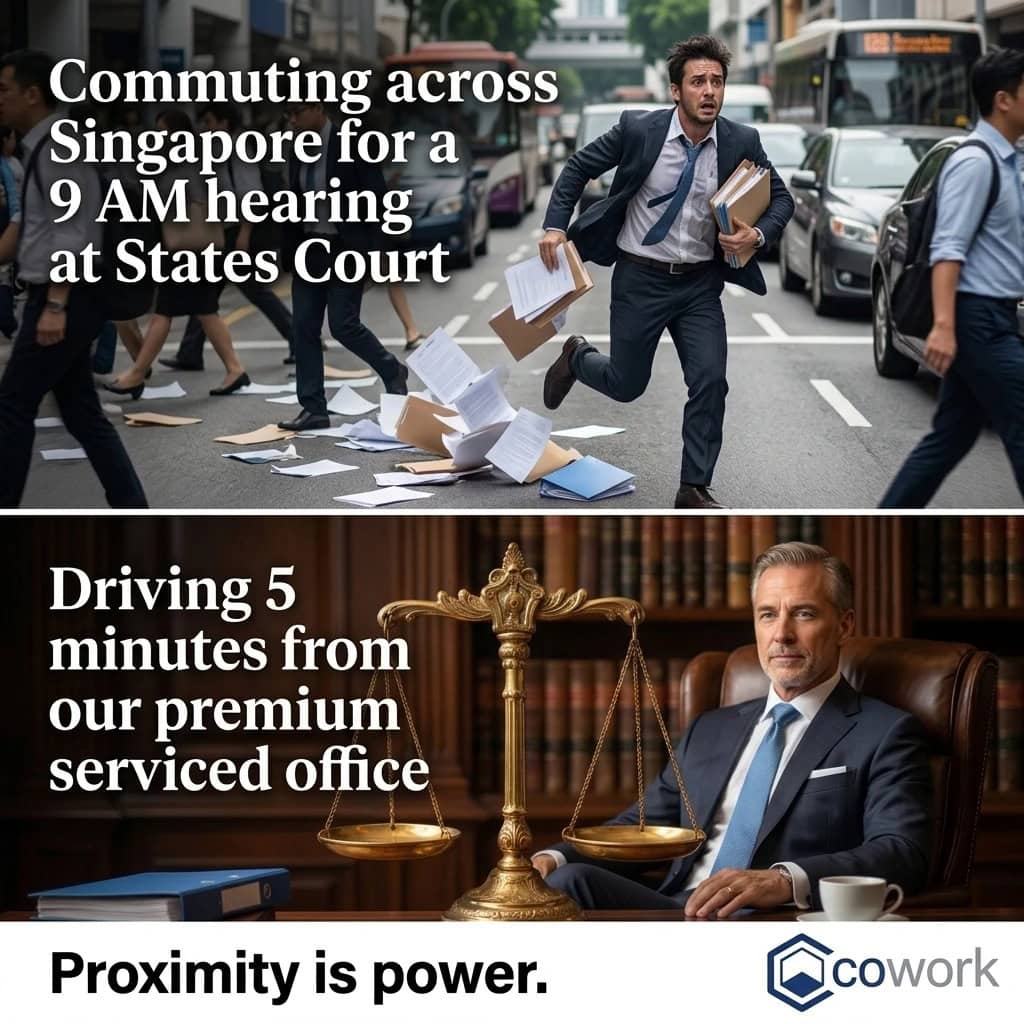
Being near the courts (see example for States Court) is a time-and-risk calculation. When hearings move, when counsel requests an in-person alignment, when a filing becomes urgent, distance becomes friction. Friction becomes cost.
A serviced office near Raffles Quay can provide meaningful proximity advantages for firms that handle litigation, arbitration support, or any practice with frequent court submissions. If your practice currently operates from the shophouse offices around Tanjong Pagar, our serviced office near Tanjong Pagar keeps you within easy reach of the courts while adding the closed-door privacy that shophouse layouts rarely offer.
Reduce Travel Time For Mentions, Filings, And Last-Minute Deadlines
Legal work often turns on hours rather than days. Travel time is rarely billable, yet it drains the very resource clients pay for: attention.
With a location close to the courts, we can:
- Shorten turnaround for mentions, urgent applications, and last-minute changes.
- Reduce stress around tight deadlines, especially when matters run late.
- Keep teams closer to the work, rather than spread across the city in transit.
The benefit becomes most visible when a day is already volatile: a hearing runs over, a client calls with a late instruction, and a document needs immediate review before filing.
Convenient Meeting Point For Counsel, Clients, And Experts
A central, recognisable area simplifies coordination with:
- Counsel and co-counsel.
- Expert witnesses and consultants.
- Clients who want discretion and efficiency rather than a long commute to an industrial park address.
The office becomes a practical staging point. Not glamorous. Just effective, in the way good operations often are.
6. Flexible Terms That Reduce Lease Rigidity And Commercial Risk
Lease rigidity is a particular kind of risk: it feels manageable when revenue is steady, then becomes a fixed cost problem when the market shifts or the caseload changes. A three-year commitment can be reasonable for some businesses.
For many law firms, it can be an unnecessary exposure.
A serviced office typically offers more flexible terms, allowing the workspace strategy to follow demand rather than fight it.
Scale Up Or Down Without Being Locked Into A 3-Year Commitment
Flexibility is often described as a convenience. In practice, it is a form of risk management.
Shorter commitments can help when:
- A firm expands quickly after winning a major instruction, then normalises after completion.
- A practice area grows seasonally or in response to regulatory cycles.
- A regional expansion needs proof before permanence.
There is a broader pattern here. Many established firms are choosing flexible office solutions for reasons that look conservative rather than trendy: capital preservation, operational simplicity, and optionality. Our overview on why small and medium enterprises choose serviced offices captures that logic without pretending every business has the same needs.
Right-Size Space As Case Load And Headcount Change
Right-sizing is not only about saving money. It is about avoiding a mismatch that creates daily inefficiency:
- Too little space forces private conversations into corridors or cafés.
- Too much space becomes a silent reminder of fixed cost.
A serviced office makes it easier to adjust the footprint so that the office remains a tool, not a liability. In investment terms, it is the difference between holding an illiquid asset and maintaining a position that can be resized as conditions change.
Similar to law firms, strategic office solutions for fund managers involve a more agile approach to space management, allowing for quick adaptations in response to market fluctuations. This flexibility can enhance operational efficiency and reduce overhead costs, making it a pivotal strategy for investment firms. By leveraging these solutions, managers can focus on growth initiatives rather than being burdened by fixed office commitments.
7. Enterprise-Grade IT And Onsite Support Without The Admin Burden

Legal teams depend on systems that must be secure, stable, and supported. The challenge is that technology management can quietly become a second business inside the firm, drawing partner attention into vendor management and troubleshooting.
A premium serviced office can provide enterprise-grade infrastructure with onsite support, reducing the administrative load without compromising security expectations.
Secure, Stable Connectivity For Video Calls, E-Discovery, And Cloud DMS
Modern legal work leans heavily on digital workflows: video conferences with overseas clients, document review platforms, and cloud-based document management systems.
A suitable serviced office setup should support:
- Consistent bandwidth for high-stakes calls where interruptions are more than an annoyance.
- Secure network practices, with sensible access controls.
- Reliability for heavy file movement, including e-discovery datasets and bundled submissions.
This is particularly relevant when teams are managing sensitive materials and must demonstrate sound operational controls. The point is not to claim perfection. It is to reduce avoidable fragility.
In-House IT Helpdesk For Fast Resolutions And Less Downtime
Downtime rarely arrives politely. It appears five minutes before a client call or during a document compilation window.
Onsite support changes the dynamic:
- Issues are addressed quickly, often without waiting for a third-party technician.
- Partners avoid becoming the escalation point for routine problems.
- New joiners can be onboarded with fewer delays and fewer improvised setups.
8. Professional Meeting Infrastructure For Client Service And Deal Execution
For law firms, meeting space is not a perk. It is part of delivery. Clients remember the environment in which they signed, negotiated, or resolved a dispute. They also remember delays, awkward logistics, and rooms that feel like an afterthought.
A premium serviced office can provide meeting infrastructure that supports serious work without requiring a firm to build and maintain it.
Bookable Boardrooms For Signings, Mediations, And Team Workshops
High-quality meeting rooms matter most when stakes are high:
- Transaction signings with multiple parties.
- Mediations where the tone of the room influences momentum.
- Internal workshops for strategy, case preparation, or client pitches.
Bookable rooms reduce the need to oversize a private office simply to accommodate occasional peak usage. That is cost efficiency with operational elegance.
Reception, Guest Handling, And Hospitality Standards Fit For Executives
Client experience begins before the meeting starts. A composed reception and thoughtful guest handling communicate reliability without saying a word.
That includes:
- Professional check-in and waiting experience.
- Discreet communication when guests arrive early or late.
- Hospitality standards that match executive expectations.
The objective is not to impress for its own sake. It is to remove distractions so the conversation stays on the matter at hand.
9. Offloaded Facilities Management So Partners Focus On Billable Work
Facilities management is a slow leak on time. It does not feel dramatic, yet it chips away at partner focus through small decisions: which cleaner, which internet plan, which repair vendor, which invoice is correct. None of it is billable. All of it is unavoidable in a traditional lease.
A serviced office moves those responsibilities to an operator whose business is running the building properly.
No Utility Bills, Cleaning Schedules, Or Vendor Chasing
With an all-inclusive model, we typically avoid:
- Utility account administration and variable monthly bills.
- Cleaning schedules, quality checks, and replacement staffing issues.
- Vendor tendering and dispute resolution for routine services.
There is also a human element. When the office is managed well, our staff stops spending energy on minor friction. That can help retention, particularly when talented employees can choose employers with better working conditions.
One Point Of Accountability For Day-To-Day Operations
When multiple vendors are involved, problems bounce between them. The internet provider blames internal wiring. The building contractor blames the router. Time passes.
A serviced office simplifies escalation:
- One operator is accountable for keeping the environment functional.
- Issues are logged and resolved through a single channel.
- The firm avoids managing a chain of subcontractors.
For partners, this is less about convenience and more about guarding attention. Attention is the scarce asset in legal practice.
10. Stability With Built-In Business Continuity And Scalable Operations
Flexibility does not need to feel temporary. Many decision-makers hesitate because they associate serviced offices with transience. The better operators deliver the opposite: a stable base with systems designed for continuity, supported by the ability to scale.
For a law firm, stability is not only physical. It sits in security controls, redundancy, and the confidence that the office will not become a failure point.
Redundancy And Security Controls That Support Risk Management
Business continuity is rarely noticed when it works. It is painfully visible when it fails.
A serviced office can support risk management through:
- Redundancy in critical services, where available.
- Access controls that align with confidentiality expectations.
- Operational discipline around visitors, deliveries, and shared spaces.
We should be cautious in assuming every building offers the same resilience, so due diligence remains important. Yet the baseline in a premium serviced environment is often higher than what a small firm can reasonably build alone without significant capex.
A Professional "Headquarters" Feel Without Long-Term Exposure
Many established firms want a headquarters that feels settled: signage, reception standards, private rooms, and meeting capacity. They also want to avoid locking capital and commitment into a single footprint that may not match the firm in two years.
A serviced office near Raffles Quay provides a practical middle ground:
- The firm presents as established and client-ready.
- The space can scale as headcount and caseload change.
- Exposure to long-term lease risk is reduced.
It is a hedged position: stable enough for credibility, flexible enough for reality.
Conclusion
Running a law firm from a serviced office near Raffles Quay is not a shortcut: it is a considered operational choice. It lowers Total Cost of Ownership through capex avoidance and predictable monthly spend, supports confidentiality with closed-door space and professional front-of-house management, and strengthens credibility with a central business district presence near the courts. Just as importantly, it replaces lease rigidity with agility, while preserving the stability that established practices require.
If we are seeking a professional headquarters that protects time, capital, and reputation, a premium serviced office delivers a strong balance of flexibility and prestige, without the long-term exposure that traditional leasing can impose.
There are many law firms along Cecil Street - if you are along Cecil Street presently, our article on 7 strategic reasons to move from cecil street office rental to raffles quay serviced office may be a relevant read.
Frequently Asked Questions
What are the main benefits of running your law firm from a serviced office within Raffles Quay?
Key benefits include lower Total Cost of Ownership through capex avoidance, fast setup in days, closed-door privacy for confidentiality, a prestigious CBD address, proximity to the courts, and flexible terms. You also get professional meeting rooms, onsite IT support, and facilities management handled for you.
How does a serviced office reduce Total Cost of Ownership (TCO) for a law firm?
A serviced office reduces TCO by bundling fit-out, furniture, internet, utilities, cleaning, maintenance, and support into a predictable monthly fee. That helps avoid large upfront capex and surprise invoices. It also cuts internal time spent managing vendors—time partners can redirect to client work.
Can a serviced office provide enough confidentiality for sensitive legal matters?
Yes—provided you choose a premium operator with true closed-door suites, sound-treated meeting rooms, and disciplined guest handling. Confidentiality is supported by controlled access, discreet reception procedures, and structured room booking to reduce accidental exposure. Always confirm privacy features during due diligence and view rooms in person.
How quickly can a law firm open in a serviced office compared with a traditional lease?
A serviced office can often be operational within days because the space is already furnished, connected, and managed—power, internet, reception, and access systems are ready from day one. By contrast, a traditional lease usually involves negotiation, fit-out, approvals, installation, and testing that can take months.
Why do law firms choose a CBD address at Raffles Quay when clients care about legal results?
Results matter most, but a CBD address still influences first impressions and practical coordination. A Raffles Quay location signals stability for high-value instructions, supports cross-border meetings, and reduces friction for client visits. Business sentiment and commercial confidence are also widely tracked by sources like The Business Times.
What should a law firm check before choosing a serviced office (IT, compliance, and security)?
Check network security options, guest Wi‑Fi separation, meeting-room privacy, access controls, and whether onsite IT can support video calls, cloud DMS, and heavy document workflows. Confirm redundancy for critical services where available, plus mail/courier handling procedures. Review contract terms for scaling desks, rooms, and notice periods.



Could you elaborate on how the serviced office model at Raffles Quay specifically supports rapid scaling operations, especially in the context of fluctuating case loads? This aspect is critical for our firm’s strategic planning.
Hey Amanda – it really depends on how long your case loads are expected to take. Some firms add an additional serviced office suite for long term work. For short term work, they add the desks they require from our coworking space offering instead. Hope that helps.
I’m curious about how the technology and IT support stack up. Is it really premium level? I’ve toured some places where they said it was top-notch, but it turned out just average.
From my experience, the definition of ‘premium’ really varies. It’d be interesting to see a detailed breakdown of what’s on offer.
Yes, we have a team who have served as CTOs before – they are familiar with whats required.
The part about offloading facilities management caught my eye. For a small practice like mine, spending less time on non-billable tasks is always a win. Thanks for highlighting this, Wilson.
This sounds appealing, but I’m curious about the catch. There’s always something that’s not mentioned upfront. How transparent is the pricing structure?
Hey Elias, our prices are as it is. We don’t like unwanted surprises, so we are transparent with our prospects and customers too. Most unexpected costs come from existing service providers – telephone lines, termination/relocation fees etc. Feel free to prepare an inventory of your contracts and we can go through them with you.
Love the idea of hitting the ground running from day one with business continuity. Makes sense for startups in the legal tech space thinking about quick scale.
The emphasis on security and confidentiality is impressive. It speaks volumes about prioritising the needs of legal professionals and their clients.
Regarding flexible terms and reducing lease rigidity – how often do you see firms actually taking advantage of this? Are there scenarios where it’s more beneficial to stay put despite a shift in needs?
Could someone explain more about the CBD address advantage? I get it’s prestigious, but does it really make a difference to clients or is it more about the firm’s image?
The proximity advantages near the courts definitely caught my attention. Reducing travel time for urgent filings or last-minute deadlines can be a game-changer for efficiency.
It’s great to see how these serviced offices can fit into our wider strategy for growth and client service. Good points made here, especially about the meeting infrastructure for deals.