

The difference between coworking space and serviced office is a question that lands on the desk of nearly every Managing Director, Country Manager, and SME Founder weighing up office accommodation in Singapore's Central Business District, whether that means a coworking space by Cecil Street or a private serviced suite. On the surface, the two categories appear interchangeable. Both promise furnished desks, working internet, and a credible business address from day one. Both sit beneath the broader umbrella of flexible workspace. Both market themselves to the same audience of directors who are tired of capital-intensive fit-outs and three-year lease commitments.
Yet beneath the marketing language sits a meaningful operational divide.
According to industry data referenced by JLL and Cushman & Wakefield in recent commentary on the Asia-Pacific flexible workspace sector, demand for premium private suites within flexible workspace operators has grown faster than demand for open-plan coworking memberships, particularly among professional services firms. The reason is straightforward. Privacy, prestige, and predictability matter to established teams in a way that does not apply to a freelancer or a two-person startup.
For directors of established small and medium-sized enterprises, branch managers of multinational corporations, and partners in legal, recruitment, technology, and consultancy practices, the choice between these two formats carries genuine commercial weight. It influences client perception, regulatory compliance posture, staff retention, and the protection of confidential matters. It also influences the total cost of ownership, the agility of the business when headcount shifts, and the speed at which a team can begin generating revenue from a new address.
This guide unpacks the difference between our raffles quay coworking space and serviced office in detail, written for executives who want clarity rather than glossy brochure language. It explains what each format offers, where they overlap, where they diverge, and how to evaluate which model is appropriate for an established team operating in Singapore's most competitive professional districts.
What Is a Serviced Office and Why Our Serviced Offices Suit Established Teams
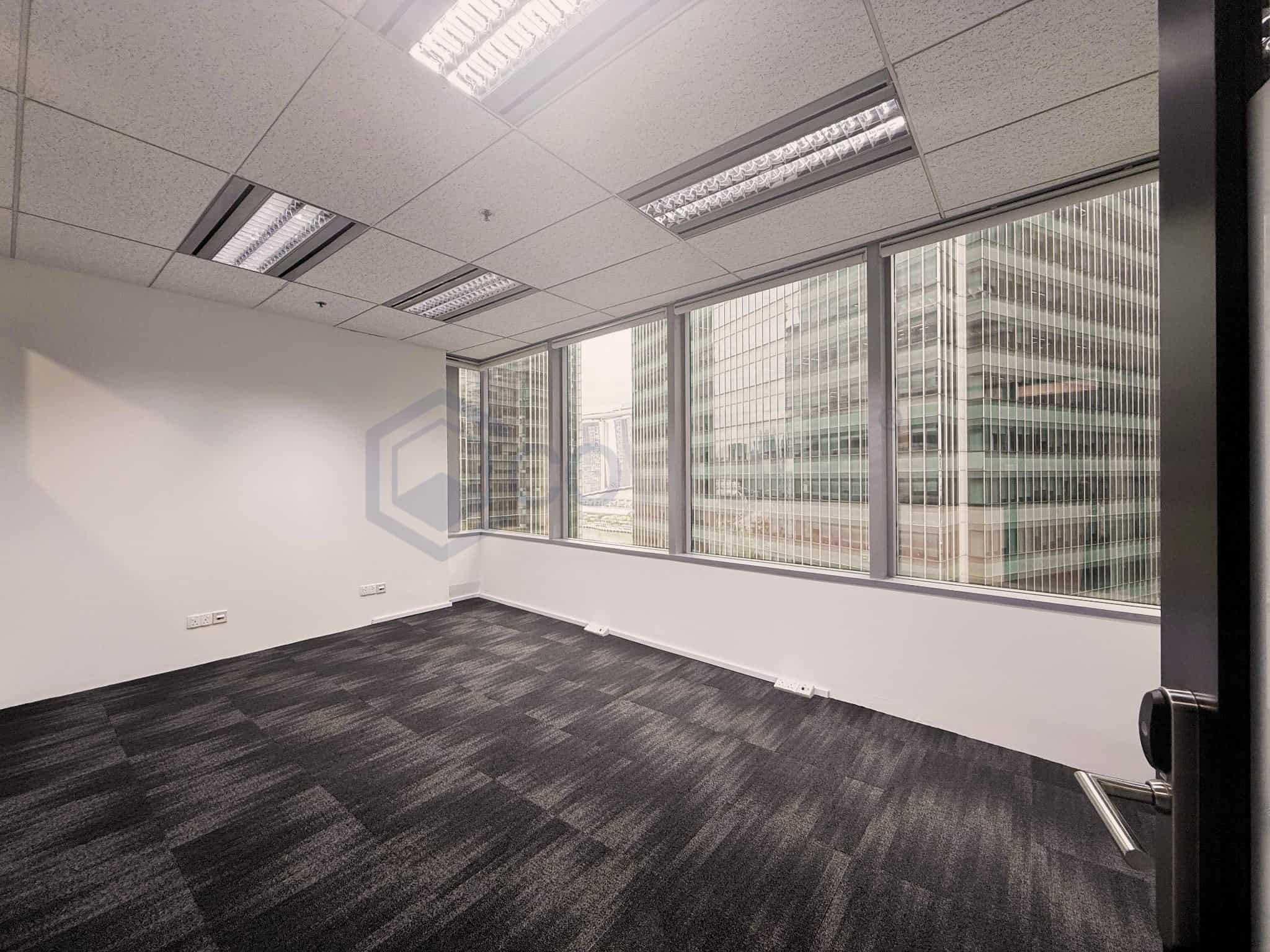
A serviced office is a fully furnished, fully managed private office suite that is leased on flexible terms by an operator who handles every aspect of facility management on behalf of the business. The space is enclosed. The door closes. The team within the suite belongs to a single business, and the suite itself is dedicated to that business for the duration of the licence agreement.
Beyond the four walls of the suite, our serviced offices provide a comprehensive package of services. This includes high-speed internet with redundant connectivity, professional reception staff who greet visitors and handle calls, daily cleaning, utilities, business-grade printing facilities, secure access control, mailroom services, and on-demand access to meeting rooms and event spaces. As a premium operator, we extend the package to enterprise-grade information technology infrastructure, including Cat 6A structured cabling, voice over internet protocol telephony, and managed network security.
The commercial logic is simple. Rather than negotiating a multi-year lease with a landlord, sinking fifty thousand dollars or more into a fit-out that may be obsolete within eighteen months, and managing a roster of vendors for cleaning, internet, security, and reception, the business pays a single monthly fee that covers everything. We absorb the capital expenditure, the operational complexity, and a meaningful portion of the risk.
For an SME founder running a recruitment practice, a partner at a boutique law firm, or the country manager of a multinational technology company opening a Singapore branch, this model addresses three of the most uncomfortable conversations that arise when expanding or relocating. The capital expenditure conversation, where the finance director questions why the business is committing scarce cash to leasehold improvements rather than revenue-generating activity. The administrative conversation, where senior staff find themselves coordinating with cleaners and internet providers rather than serving clients. The lease rigidity conversation, where the business is locked into space it has either outgrown or no longer needs.
Our serviced offices are, in essence, a workspace that behaves like a managed service. The member consumes office accommodation the way a business might consume cloud computing or managed information technology services. The cost is predictable, the service level is defined, and the responsibility for the underlying infrastructure sits with us.
What Is a Coworking Space and How Our Coworking Space Differs From the Open-Plan Stereotype
A coworking space, in the broader market, is generally understood as a shared workspace environment where individuals and teams from different organisations occupy the same physical floor, often with overlapping access to common areas, hot desks, and shared meeting facilities. The format originated as a response to the needs of freelancers, digital nomads, and very small startup teams who wanted a professional alternative to home offices and cafes without the commitment or cost of a private office.
Our coworking space is structured differently, and the distinction matters for directors who associate coworking with noise, exposure, and disruption. We do not operate an open-plan floor with hot desks scattered through a busy room. Our coworking space is a shared suite with a small number of dedicated desks — up to three within the suite — which means that members occupy a defined, enclosed environment alongside no more than two other businesses at most. The desks are dedicated, not rotated. Each member retains the same workstation rather than choosing a different seat each day.
This configuration matters in practice. The acoustic environment is closer to a private office than to a typical coworking floor. The visual exposure is limited to a handful of professional neighbours rather than a constantly changing cohort of strangers. The pace of the suite is set by the businesses inside it, not by an open floor that has been engineered for serendipitous encounter.
For freelance designers, early-stage founders testing a new venture, or remote workers whose home offices have become untenable, a typical open-plan coworking environment can be productive enough. For an established team handling confidential matters, conducting client interviews, or running negotiations behind a closed door, the open-plan format introduces friction that undermines the work. Our coworking space sits between these poles. It offers the flexibility and lower price point of a shared arrangement without the noise, movement, and visual exposure that directors of professional services firms typically wish to avoid.
The cultural difference between coworking and serviced offices, in the wider market, remains pronounced. Coworking spaces are often designed to facilitate visibility, networking, and serendipitous encounter, with bright colours, exposed ceilings, communal benches, and event calendars that encourage members to interact. The operational rhythm assumes that members value being part of a community and are comfortable with the noise, movement, and occasional unpredictability that comes with a shared environment. Within our coworking suite, by contrast, the environment is calmer and more contained, which is the deliberate design choice we have made for our audience.
The Core Difference Between Coworking Space and Serviced Office at a Glance
Distilling the difference between coworking space and serviced office into a single sentence is difficult, because the two categories operate along several axes simultaneously. A more useful approach is to consider how each format performs against the criteria that matter most to a director making the decision.
On privacy, our serviced offices offer a closed, lockable suite that belongs to one business and is configured for that business's working patterns. Our coworking space, while quieter and more contained than the open-plan norm, still operates on a shared model where one or two other businesses occupy adjacent dedicated desks within the same suite. For teams whose work involves confidential client matters, regulated communications, or sensitive negotiations, this distinction is rarely a marginal consideration.
On prestige and brand presentation, our serviced offices allow the business to receive clients into a dedicated environment that reflects the brand of the business itself. Reception staff can be briefed to greet visitors by name. Meeting rooms can be booked with confidence that they will be available at the precise time required. The visual identity of the suite can, within reason, be adapted to reflect the member's standards. Our coworking space presents a more shared experience, although the small footprint and limited number of co-occupants soften the effect compared with a typical open-plan coworking floor.
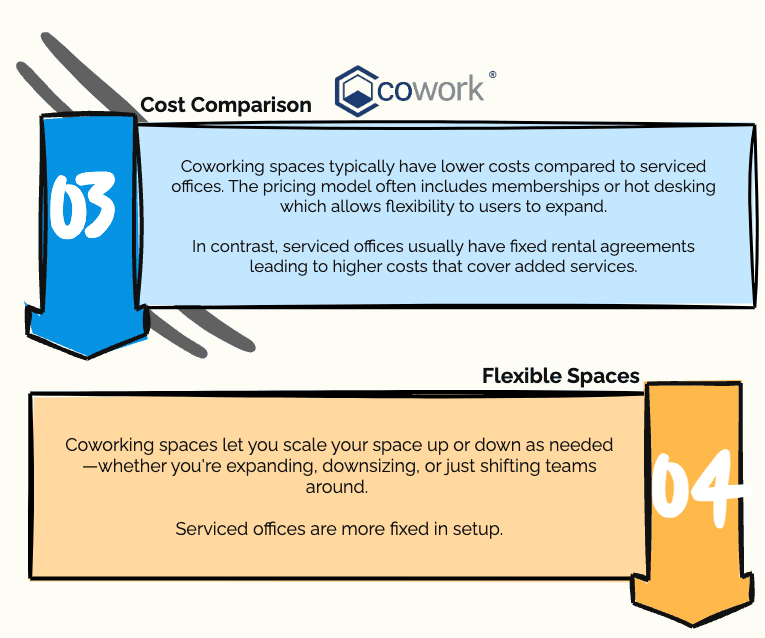
On cost, the picture is more nuanced than is sometimes claimed. A coworking dedicated desk is almost always cheaper on a per-seat basis when measured in isolation. A dedicated desk in our coworking suite costs considerably less per month than a private serviced suite for a team of six. However, when the comparison is widened to include meeting room usage, privacy requirements, the productivity cost of distraction, and the reputational implications of receiving senior clients in a shared environment, the gap narrows significantly. For a team that needs daily access to private meeting rooms, the bundled cost of one of our serviced offices often compares favourably to a coworking arrangement with a la carte meeting room bookings.
On flexibility, both formats outperform a traditional lease by a wide margin. The granular question is whether the flexibility is needed at the seat level or at the suite level. Our coworking space can be taken on shorter terms and with the ability to add or release individual desks with minimal notice. Our serviced offices allow members to scale by adding adjacent suites, dedicated desks within the coworking suite, or short-term project space without renegotiating the underlying agreement.
On infrastructure, the difference is more meaningful than the marketing language often suggests. Most coworking operators in the broader market offer Wi-Fi, a shared printer, and limited availability for anything beyond that.
Dedicated network ports, segmented virtual local area networks, dedicated trader workstations, network attached storage for shared files, voice over internet protocol telephony with direct inward dialling, and closed-circuit surveillance for sensitive areas all sit outside what a typical coworking membership accommodates.
For a professional services firm that depends on these systems, the gap between a coworking arrangement and a properly equipped private suite becomes operationally significant. As a premium operator, we have invested in enterprise-grade IT services setup in serviced offices — including structured Cat 6A cabling, redundant internet connections, and managed network security — across our serviced offices, with the same backbone available to members of our coworking suite.
A coworking operator catering to a broader audience may offer adequate Wi-Fi but is less likely to provide the kind of dedicated, segmented network infrastructure that compliance-conscious businesses require.
How the Difference Plays Out for Professional Services Firms
For directors of legal practices, recruitment firms, consultancy partnerships, and technology companies, the difference between coworking space and serviced office is rarely abstract. It manifests in specific operational moments that recur throughout the working week.
Consider a recruitment partner conducting a candidate interview. The conversation involves remuneration, current employer, reasons for considering a move, and references. None of this can occur within earshot of strangers without compromising the candidate's confidence in the process. One of our serviced offices allows the partner to close the door of their suite, conduct the interview without interruption, and walk the candidate through reception in a manner that feels considered rather than improvised. A coworking environment, even a contained one such as ours, requires the partner to book a meeting room in advance and accept that the interview occurs outside their immediate workspace.
Consider a legal practitioner reviewing privileged correspondence on a laptop screen. In one of our serviced office suites, the screen is visible only to colleagues within the same business. In our coworking suite, the screen would be visible to members of one or two other businesses sharing the room, which, although a far cry from the exposure of an open-plan coworking floor, is still a consideration for matters involving privilege.
Consider a consultancy team conducting a sensitive client workshop on commercial strategy. The discussion involves competitor analysis, pricing, and internal politics within the client organisation. The team needs a room they can configure, occupy for several hours, and leave with confidence that nothing remains on the whiteboard for the next occupant to read. Our serviced offices accommodate this without negotiation. Our coworking arrangement, supported by booked meeting rooms, can accommodate it as well, although the booking and room handover require active management.
These examples are not theoretical. They are the texture of professional services work, and they help explain why the most established firms in finance, legal, and advisory services have continued to favour private offices, including premium serviced offices, even as the broader flexible workspace market has expanded.
The Capital Expenditure Question and How Both Formats Address It
One of the strongest arguments for either format, as compared to a traditional leased office, is the elimination of upfront capital expenditure on fit-out. For an SME director who has previously signed off on a renovation budget, the experience tends to leave a mark. Design fees, contractor deposits, furniture orders, network cabling, access control systems, and the inevitable variations when a design meets the constraints of a real building can comfortably exceed fifty thousand Singapore dollars before the first employee occupies the space. If the business outgrows the premises, contracts in size, or relocates within eighteen to twenty-four months, the return on that capital is poor.
Our coworking space eliminates this expenditure entirely. The member pays a monthly fee and walks into a fully equipped environment that we have already capitalised. Our serviced offices do the same thing for a private team, with the additional benefit that the suite itself is configured for the business's exclusive use. In both cases, the capital that would otherwise have been tied up in leasehold improvements remains available for revenue-generating activity, whether that involves hiring fee earners, investing in technology, or extending working capital.
The difference between the two formats, on this specific dimension, is therefore one of degree rather than kind. Both protect the business from the capital expenditure trap. Our serviced offices do so while also delivering the privacy and prestige that a private suite provides. Our coworking space does so at a lower price point, with the trade-off that the member shares the suite with up to two other businesses.
Lease Rigidity, Agility, and the Total Cost of Ownership
The total cost of ownership of an office is rarely captured by the headline rent figure. In a traditional lease arrangement, the business is responsible for fit-out, utilities, internet, cleaning, security, reception, maintenance, and reinstatement at the end of the term. Each of these line items represents both a cash cost and an administrative burden. The cumulative effect is that the true monthly cost of a traditional leased office is often thirty to fifty per cent higher than the rent alone suggests, before the implicit cost of management time is considered.
A flexible workspace, whether one of our coworking dedicated desks or one of our serviced offices, bundles most or all of these costs into a single monthly fee. The member knows what the office will cost next month, and the month after, with a degree of precision that a traditional lease rarely provides. This predictability has commercial value in its own right. It allows the finance director to forecast accurately, the country manager to defend the budget to head office, and the founder to model growth scenarios without absorbing operational variability.
Agility is the second pillar of the total cost of ownership conversation. A team that grows from ten to thirteen people in one of our serviced offices can often add a dedicated desk in our coworking suite or take an adjacent serviced suite without disruption. A team that contracts can release space at the end of the licence period without facing a reinstatement bill. In our coworking arrangement, the agility is even more granular, with desk-level adjustments possible on short notice. In a traditional lease, by contrast, both growth and contraction trigger meaningful friction. Adding three people may require taking more space than is needed; releasing space may require subletting or absorbing the cost until lease expiry.
For SME directors operating in volatile markets, where a single client win or loss can shift headcount requirements by twenty per cent, this agility is not a luxury. It is the difference between an office that supports the business and an office that constrains it.
Why We Combine Both Formats Under One Roof
The flexible workspace market has matured to the point where the most thoughtful operators no longer treat coworking and serviced offices as competing products. We offer both within the same building, allowing members to choose the arrangement that fits the moment and to adjust as circumstances change.
The logic is compelling. A growing professional services firm might begin with one of our serviced offices for the core team of six, then add a dedicated desk in our coworking suite when a project requires temporary capacity, then release that desk back to us when the project ends. The same operations team manages the entire arrangement. The same reception greets the team's visitors. The same information technology infrastructure supports the work. Continuity is preserved while flexibility is delivered.
This combined model is particularly suited to SME directors and country managers who value stability above all else. Our serviced offices provide the headquarters function, with the privacy, prestige, and predictability that the role demands. Our coworking space — a shared suite rather than an open floor — provides the buffer for growth, project work, and visiting colleagues from overseas offices, without the noise and exposure of a typical coworking environment. The member is not forced to choose between the two, and the boundary between them becomes a matter of operational convenience rather than commercial constraint.
For the director comparing the difference between coworking space and serviced office, the most useful question may therefore not be which format to choose, but whether the operator under consideration offers the ability to use both as needed. In a market like Singapore's Central Business District, where supply is constrained and lead times can be long, the optionality of a combined model has measurable commercial value.
How to Evaluate Operators Beyond the Headline Difference
Once the conceptual difference between coworking space and serviced office is understood, the practical evaluation of specific operators becomes the next priority. Three areas deserve particular attention from directors who are weighing up options in Singapore.
The first is the quality of the information technology infrastructure. For professional services firms, the network is the office. A serviced office in a prestigious Central Business District building with weak Wi-Fi, no structured cabling, and an internet connection that drops during important calls is not fit for purpose, regardless of how impressive the lobby looks. Directors should ask specific questions about cabling standards, redundancy of internet connections, network segmentation between businesses, and the operator's incident response process when connectivity fails. An operator that has invested in Cat 6A cabling, dual internet providers, and managed network security signals an understanding of what professional services work actually requires.
The second is the calibre of the on-site team. A serviced office is, in essence, a service business. The reception, the facilities team, and the operations manager are the people who determine whether the experience meets the standard that was promised at the time of signing. Directors should meet the team before signing, observe how visitors are handled, and form a view on whether the team operates with the discretion and professionalism that the business requires. A polished suite with an indifferent reception is a poor investment.
The third is the operator's track record on stability. Flexible workspace operators have a varied history globally, with some prominent failures alongside many successful businesses. For SME directors who value stability, the financial health of the operator, the length of their head lease, and their ownership structure all matter. An operator that owns or has a long-term commitment to the building it operates from offers a different stability profile to one that is itself on a short-term arrangement. This is not a question that members always think to ask, but it is one that materially affects the risk of disruption.
Making the Decision: A Framework for Directors
The decision between coworking and serviced office, in practice, often resolves itself once a director has clarified four things about the business.
The first is the nature of the work. Confidential, regulated, or client-facing work points strongly towards a serviced office. Independent, project-based, or collaborative work can be accommodated comfortably in a coworking arrangement, particularly one structured as a shared suite with a small number of dedicated desks rather than an open floor.
The second is the team size and trajectory. A core team of five or more, particularly one that expects to grow, generally benefits from a private suite as a base, with optional coworking access for flex capacity. A solo operator or a team of two or three may find a coworking arrangement entirely adequate, at least until the business reaches a scale where privacy becomes essential.
The third is the importance of brand and client experience. Businesses whose clients judge them on their premises, whether explicitly or implicitly, benefit from the controlled environment of a serviced office. Businesses whose clients rarely visit or who operate in a more informal sector may not need the same level of presentation.
The fourth is the appetite for trade-offs. A coworking arrangement offers lower cost in exchange for less privacy. A serviced office offers more privacy in exchange for higher cost. A combined arrangement, where a private suite is supplemented by access to dedicated desks in a shared coworking suite, offers most of the benefits of both, in exchange for a slightly more complex commercial structure. There is no objectively correct answer; there is only the answer that fits the business.
For most established SMEs and multinational branches in legal, recruitment, technology, and consultancy services in Singapore, the answer in practice tends to be a serviced office with optional coworking access. The combination delivers the headquarters function, protects against capital expenditure risk, and preserves the agility to scale without renegotiation. It is, in many respects, the executive's compromise between control and flexibility.
Frequently Asked Questions
1. What is the main difference between a coworking space and a serviced office? The main difference lies in privacy and dedication of space. A serviced office provides a fully enclosed, private suite for the exclusive use of one business. A coworking space, in the broader market, is typically a shared environment, although our coworking space is structured as a shared suite with up to three dedicated desks rather than an open floor.
2. Which is more suitable for a small or medium-sized enterprise in Singapore? For an established SME with five to twenty staff, particularly in professional services, one of our serviced offices is generally more appropriate because it provides the privacy, prestige, and consistency that client-facing work requires. Our coworking space can complement this for project-based or temporary capacity.
3. Is a serviced office more expensive than a coworking space? A serviced office typically commands a higher monthly fee than a coworking dedicated desk on a per-seat basis. However, when meeting room usage, privacy, and infrastructure are included in the comparison, the gap narrows considerably for teams that require regular private meeting access.
4. Can a serviced office offer the same flexibility as a coworking space? Yes, our serviced offices offer comparable flexibility, particularly because we allow members to scale by adding dedicated desks in our coworking suite or taking an adjacent serviced suite without renegotiating the licence agreement. The flexibility may be at the suite level rather than the seat level.
5. Which format is better for handling confidential client information? Our serviced offices are better suited for confidential work because they provide a lockable, enclosed suite with controlled access. Our coworking space, although quieter and more contained than an open-plan coworking floor, is still a shared suite and therefore presents some level of exposure to neighbouring businesses.
6. How long are the typical commitment periods for each format? Coworking dedicated desks are commonly available on shorter, more flexible terms. Serviced office licence agreements vary by operator but often start from three months and extend up to twenty-four months, with terms that remain considerably more flexible than a traditional commercial lease.
7. Do serviced offices and coworking spaces include information technology infrastructure? Both formats typically include Wi-Fi as a baseline. Premium serviced offices generally provide more robust infrastructure, including structured Cat 6A cabling, redundant internet connections, and segmented network security, which is particularly valuable for regulated industries. Our coworking space benefits from the same infrastructure standard, given that both sit within the same building.
8. Can one operator provide both serviced office and coworking solutions? Yes. We offer both formats within the same building at 6 Raffles Quay. This combined model allows businesses to maintain a private headquarters while accessing additional desks in our coworking suite as needs change.
9. What kind of businesses choose coworking over serviced offices? Coworking arrangements are typically chosen by freelancers, early-stage startups, remote workers, and very small teams that prioritise cost flexibility over privacy and dedicated space. Our coworking space, structured as a shared suite, also appeals to small teams who value a calmer environment than a typical open-plan coworking floor.
10. How does each format compare to a traditional commercial lease? Both formats eliminate upfront capital expenditure on fit-out, bundle utilities and services into a single fee, and offer flexible commitment periods. A traditional lease provides greater customisation and long-term unit economics but requires significant capital, administrative effort, and a multi-year commitment.
Difference between coworking space and serviced office is, ultimately, a question of fit. For directors who have weighed the trade-offs and concluded that a private headquarters with optional flexibility is the correct answer, our offering at 6 Raffles Quay is built precisely for this profile of business. To explore our serviced offices and our coworking suite in person, arrange a viewing tour at the address.


This article does a great job of clarifying coworking versus serviced offices. As an SME founder, I find the predictable costs of serviced offices really appealing.
I wonder how the privacy in serviced offices compares to coworking spaces? Is it really that much better?
I’ve always viewed coworking spaces as somewhat chaotic. This article changes my perspective on how they can be structured.
The total cost of ownership is crucial. It’s good to see that explained clearly in the article.
With the recent economic shifts, flexibility is so important. Serviced offices seem like a smart choice now.
Can someone explain how meeting room access works in these setups? Are they usually included?
I appreciate the straightforward breakdown of services. It makes it easier to decide which option is better for our team.
Seems like a serviced office is a more comprehensive solution for established teams. Definitely worth considering.
Do you think coworking spaces will become a thing of the past? I feel like a lot of businesses will prefer more privacy now.
This article confirms what I’ve been thinking about office flexibility. I work in a tech startup and we need to adapt quickly.
The focus on privacy and compliance for serviced offices is particularly important for law firms. I see why it’s a preferred choice.
I think the service aspect of serviced offices is really beneficial for small teams who don’t want to manage everything.
Loved the video link at the end. It helps to visualise the differences further.