

The post-pandemic workplace has produced a peculiar paradox for the established business leader.
On one hand, the residential study has been elevated from an occasional refuge into a fully equipped command centre, complete with ergonomic seating, dual monitors, and fibre broadband. On the other, the boardroom remains the venue where deals are closed, talent is acquired, and institutional credibility is demonstrated.
For the founder of a professional services firm, the country manager of a multinational branch, or the managing director of a growing consultancy, the question is no longer whether remote work is viable. The question is whether the residential setting can sustain the weight of executive responsibility over the long term, particularly when client expectations, regulatory scrutiny, and team scalability are involved.
This examination of work from home vs coworking spaces at 6 raffles quay is written for the decision-maker who has outgrown the binary debate. Such a leader recognises that an office is not merely a desk with a chair; it is a strategic asset that signals prestige, protects confidentiality, and provides operational stability. In the sections that follow, we shall explore the genuine trade-offs between the two environments, address the hidden costs that rarely appear on a spreadsheet, and explain why a serviced coworking arrangement at a Central Business District address has become the preferred middle path for executives who require agility without compromising authority.
The Shifting Landscape of Professional Workspace
A decade ago, the choice was straightforward. A business of any consequence held a traditional lease, fitted out a bare-shell unit at considerable expense, and amortised the capital expenditure over a multi-year horizon. The home office was reserved for freelancers, sole traders, and those whose work was largely solitary. Coworking spaces, where they existed, served the start-up community and the itinerant consultant.
That world has dissolved. The rise of distributed teams, the volatility of commercial property markets, and the maturation of flexible workspace operators have collectively rewritten the rulebook. Today, the established small or medium-sized enterprise faces a far more nuanced set of options, each carrying distinct implications for cost structure, team productivity, client perception, and strategic agility. The director who fails to appreciate these implications risks either over-committing capital to a depreciating fit-out or under-investing in the professional infrastructure that growth ultimately demands.
Within this evolving landscape, the comparison between domestic working arrangements and a properly appointed coworking environment is no longer a matter of preference alone. It has become a question of business architecture, and the consequences of a poor decision tend to surface gradually, often in the form of stalled deals, distracted hires, and the quiet erosion of professional reputation.
Working from Home: The Hidden Anatomy of a Domestic Office
The appeal of the home office is intuitive. There is no commute to absorb productive hours, no rental obligation to satisfy at month-end, and no morning ritual of navigating crowded transit corridors. For the executive who values autonomy, the residential setting offers an ostensibly seamless integration of professional output and personal flexibility.
Yet, beneath this convenience lies a less examined reality. The home office, when scrutinised through the lens of executive responsibility, reveals a series of structural limitations that traditional analyses tend to overlook.
The Question of Professional Image
When a prospective client arrives for a discovery meeting, the environment in which they are received communicates a great deal before a single word is exchanged. A residential address, however tasteful, struggles to convey the institutional permanence that established clients tend to expect from their legal counsel, their recruitment partner, or their technology consultant. Video calls conducted against the backdrop of a bookshelf or a curated wall may suffice for routine catch-ups, but the moment a deal of significance is on the table, the limitations of the domestic setting become apparent.
This matters acutely for regulated industries. Asset managers, legal practitioners, and certain financial advisers are bound by professional standards that touch upon the suitability of their place of business. Even where the regulatory bar is satisfied, perception within the market often runs ahead of compliance. A managing director seeking to attract senior talent or to be considered for tier-one mandates is well advised to weigh the reputational weight of their address with care.
The Erosion of Confidentiality
Privacy at home is rarely as secure as it appears. Family members, domestic helpers, building maintenance staff, and visiting tradespeople pass through residential spaces with regularity. Sensitive negotiations, board-level discussions, and confidential client briefings demand a controlled environment in which the integrity of the conversation is structurally protected.
For a founder negotiating a term sheet, a country manager discussing a regional restructuring, or a partner reviewing privileged correspondence, the absence of a closed-door professional setting introduces a quiet but persistent risk. It is the kind of risk that does not announce itself until it materialises, by which time the cost is rarely recoverable.
The Blurring of Boundaries
The literature on remote work has documented, with increasing rigour, the toll that an undefined boundary between home and office takes upon executives over time. Without the physical act of leaving the workplace, the working day expands silently. Evenings dissolve into email triage. Weekends accommodate proposal drafting. The cognitive disengagement that allows for genuine recovery becomes elusive, and decision-making quality suffers accordingly.
For a leader whose judgement is the firm's principal asset, this gradual depletion is not a personal indulgence to be dismissed. It is a strategic concern.
The Limits of Networking
Business development, particularly for professional services, depends substantially on the serendipitous encounter, the corridor conversation, the introduction made over coffee. The home office, by its nature, severs the leader from these informal channels. While digital networking has its merits, it is a poor substitute for the dense relational ecosystem that a well-located professional address provides.
The Coworking Proposition: Structure Without the Capex Burden

A coworking environment, properly conceived, addresses each of the limitations enumerated above. It restores professional separation between work and home, provides a credible address for client engagement, and reintroduces the leader to a community of peers. Yet not all coworking offerings are equal, and the executive evaluating this option must understand the spectrum on which different operators sit.
At the lower end, coworking is essentially a populated hot-desking arrangement, suited to the freelancer and the early-stage entrepreneur. At the upper end, it approaches the character of a serviced office, complete with private suites, dedicated meeting facilities, and concierge-grade administrative support. The terminology overlaps considerably, but the operational reality differs substantially.
For the established SME or branch office, the relevant comparison is not between the home and a hot desk. It is between the home, a traditional leased office, and a premium coworking or serviced office solution that combines the privacy of the former with the agility of the latter.
Eliminating the Capital Expenditure Risk
The traditional lease model carries a capital exposure that has, over the past several years, become increasingly difficult to justify. A bare-shell fit-out for a unit of modest dimensions readily exceeds fifty thousand dollars once partitioning, electrical work, network cabling, furniture, and decorative finishing have been accounted for. This sum, once spent, is largely irrecoverable. Should the team expand more rapidly than anticipated, or contract in response to market conditions, the fit-out becomes a sunk cost that constrains rather than supports the business.
A premium coworking arrangement removes this exposure entirely. The space is delivered fully fitted, professionally furnished, and immediately operational. Capital that would otherwise have been consumed by depreciation is preserved for revenue-generating deployment, whether that be hiring, marketing, or product development. The financial logic, when laid out plainly, tends to favour the flexible model with increasing decisiveness as market volatility persists.
Releasing the Executive from Administrative Drag
The administrative load associated with running a conventional office is rarely reflected in the headline rent figure. Utilities must be contracted, cleaning rosters maintained, internet and telephony providers engaged, office supplies replenished, and pantry inventories managed. Each of these activities, taken in isolation, is trivial. Aggregated across a working month, they constitute a meaningful tax on executive time and attention.
For the managing director whose hourly value to the business runs into the hundreds of dollars, the opportunity cost of these activities is substantial. A serviced coworking arrangement — a coworking desk near Tanjong Pagar, for instance — consolidates them under a single operator, who delivers them as part of an integrated service. The leader is thereby released to focus upon what only the leader can do, which is to direct the firm's strategic course.
The Lease Flexibility Imperative
Traditional leases of two or three years' duration assume a degree of forward visibility that the contemporary market rarely supports. Hiring plans accelerate or decelerate in response to client demand, regulatory shifts, and macroeconomic conditions. A workspace arrangement that requires the business to commit to a fixed footprint over an extended horizon is, in effect, a wager against the future. Such wagers occasionally pay off, but more often they constrain the firm's capacity to respond to opportunity.
The flexible arrangement permits scaling in either direction with comparatively little friction. A team may expand from a private suite of four to one of eight, or contract from twelve to six, without the punitive consequences that a traditional lease would impose. This optionality has a quantifiable value, and prudent finance directors are increasingly recognising it as such.
How CoWorkSpace at Raffles Quay Resolves the Executive's Dilemma
Within the Singapore market, the choice of operator and location merits particular attention. The Central Business District, and within it the Raffles Quay precinct, occupies a position of distinct commercial gravity. Its proximity to major banking institutions, established legal firms, and the Marina Bay financial corridor lends an address in this area a weight that few alternatives can match.
CoWorkSpace at 6 Raffles Quay has been designed with the established SME, the branch office of a multinational, and the regulated professional firm in mind. The proposition is constructed around four principles that speak directly to the executive's core requirements.
A Prestigious Central Business District Address
The address itself is a strategic asset. Situated within walking distance of Raffles Place MRT, it places the business at the geographic heart of Singapore's financial district. Clients arriving for meetings encounter an environment that signals seriousness of intent. Senior hires considering an offer find themselves drawn to a workplace that matches their professional aspirations. Partners and counterparties form their initial impression of the firm against a backdrop that supports rather than undermines the firm's positioning.
For regulated industries, where the address may form part of the regulatory submission or the licensing record, the institutional weight of the location carries an additional dimension. It is not merely a matter of perception; it is a matter of suitability.
Privacy and the Closed Door
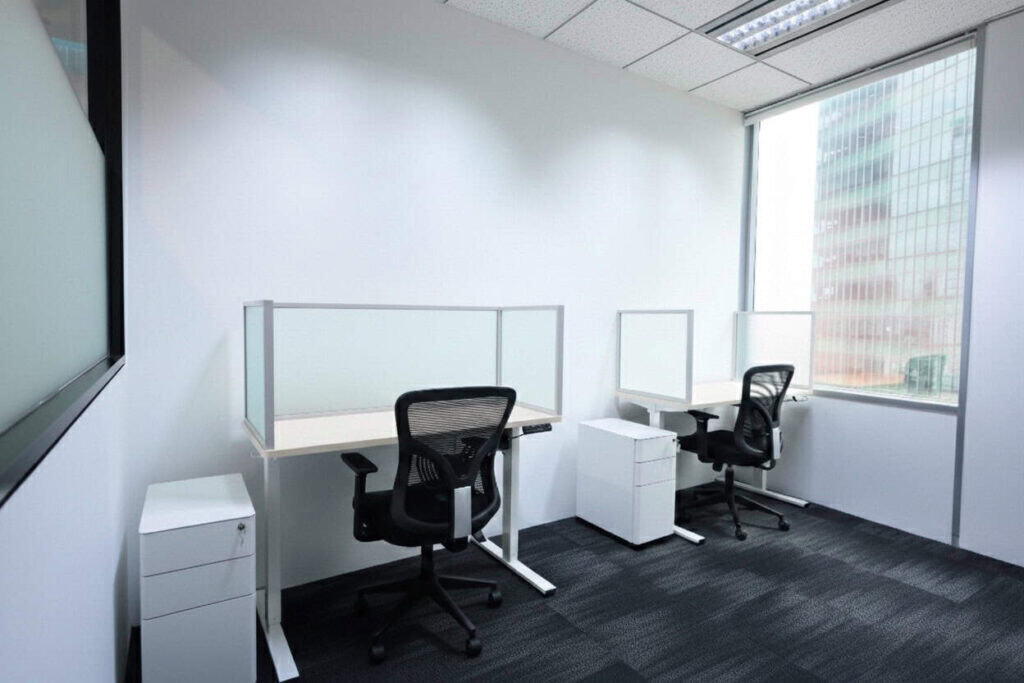
Where the open-plan coworking arrangement falls short, CoWorkSpace's private suites restore the executive standard. Closed-door offices, configurable in size from intimate to team-scale, allow for the confidential conduct of business that professional services demand. Meetings of sensitivity may be held in dedicated rooms, equipped to a standard that supports both client engagement and internal deliberation.
For the founder negotiating a partnership agreement, the country manager conducting a performance review, or the legal practitioner reviewing privileged matters, the structural integrity of privacy is a non-negotiable feature of the working environment. It is provided here as a matter of design rather than as an exception.
Plug-and-Play Operational Readiness
The transition from contract to occupancy is measured in days rather than months. The space arrives furnished, networked, and ready for immediate use. High-speed internet infrastructure, supported by in-house IT expertise, ensures that connectivity does not become a recurring source of disruption. Mail handling, secure lockers, document services, and pantry facilities are integrated into the offering, removing the customary friction of office establishment.
The leader who signs a contract on a Friday may, in practical terms, be operating from their new headquarters by the following Monday. For a business that values speed of execution, this compression of the establishment timeline is itself a competitive advantage.
Scalability Without Lease Penalty
The team that grows from five to fifteen over the course of eighteen months requires a workspace partner who can accommodate that trajectory without forcing a relocation. CoWorkSpace's portfolio of suites and configurations permits the business to expand its footprint as the headcount develops, with the contractual flexibility to adjust in either direction. The arrangement preserves agility while delivering the stability of a fixed address, which is the combination that the contemporary executive most consistently requires.
Comparing the Two Environments Side by Side
To the executive weighing working from home against a serviced coworking arrangement at Raffles Quay, the analysis ultimately reduces to a question of fit between the workspace and the stage of the business.
The home office serves admirably for the sole practitioner whose client base is established, whose work is largely independent, and whose reputational positioning is already secure. It is, however, a constrained environment for the firm that aspires to grow, to attract senior talent, to engage tier-one clients, and to project the institutional weight that such ambitions require.
The coworking and serviced office solution at a CBD address — a coworking desk near Cecil Street, say — resolves these constraints. It delivers a professional environment without the capital exposure of a traditional lease, releases the executive from administrative tasks that consume disproportionate attention, and provides the agility to scale the team in line with commercial reality. The cost, expressed as a monthly outflow, is readily justified against the productivity gain, the reputational uplift, and the optionality preserved.
A Note on Total Cost of Occupancy
Executives accustomed to financial discipline will, quite properly, wish to interrogate the cost differential. The headline figure of a private suite at a Raffles Quay address may, on first inspection, appear to exceed the marginal cost of a home office. The comparison, however, is incomplete unless several adjustments are made.
The home office carries hidden costs that rarely appear in the household budget. Electricity consumption increases. Air-conditioning runs longer. Domestic infrastructure requires upgrades to support business-grade connectivity and security. Time lost to administrative tasks, distractions, and the absence of professional facilities translates into reduced billable hours or delayed strategic initiatives. When these factors are honestly accounted for, the implicit cost of the home office is materially higher than the headline suggests.
Conversely, the serviced office consolidates a wide array of expenses, from utilities and cleaning to internet, IT support, mail handling, and meeting room access, into a single predictable monthly figure. The chief financial function gains visibility, the budgeting cycle becomes simpler, and the variability that traditional offices introduce is largely eliminated.
When the comparison is constructed on a like-for-like basis, the serviced coworking solution at a prestigious address generally emerges as the more efficient deployment of capital, particularly for the established SME whose growth ambitions justify the investment in a credible institutional presence.
Concluding Reflections for the Executive Decision-Maker
The choice between working from home and engaging a serviced coworking environment is, in the final analysis, a choice about the kind of business one intends to build. The home office, for all its convenience, carries structural limitations that become more pronounced as the firm matures. The serviced coworking arrangement, particularly one located at a prestigious CBD address, addresses those limitations directly while preserving the financial and operational flexibility that the contemporary market demands.
For the founder, managing director, or country manager who has reached the point at which the residential arrangement is beginning to constrain rather than enable the business, the question is not whether to move, but where and on what terms. CoWorkSpace at Raffles Quay has been constructed to answer that question with clarity, offering an environment in which prestige, privacy, plug-and-play readiness, and scalability are delivered as a coherent whole rather than as separate features to be assembled by the client.
A tour of the premises remains the most efficient means by which the executive may evaluate the fit. The arrangement, once experienced in person, tends to clarify decisions that abstract comparison alone leaves unresolved.

The rise of remote work has given professionals more flexibility than ever.
While some thrive in the comfort of their homes, others prefer the structure and networking opportunities of coworking spaces. Both options have pros and cons—your ideal choice depends on work style, job demands, and personal preferences.
Frequently Asked Questions: Working from Home Versus Our Coworking Spaces
1. Is a coworking space genuinely more productive than working from home for an established business?
For an SME founder or country manager whose decisions carry weight beyond personal output, the productivity question extends well beyond the individual desk. Industry research consistently indicates that professionals report meaningfully higher levels of productivity in a structured coworking environment compared with a residential setting, with the difference attributed to fewer ambient distractions, the discipline imposed by a dedicated workspace, and the cognitive separation between professional and personal life. For the executive whose calendar is densely populated with client engagements, internal reviews, and strategic deliberations, these structural advantages translate into measurable improvements in throughput. A serviced coworking arrangement at a Central Business District address, such as CoWorkSpace at Raffles Quay, further consolidates the advantage by removing the administrative interruptions that erode executive focus over the course of a working day.
2. What are the hidden costs of running an office from home that executives tend to overlook?
The headline saving associated with the home office rarely survives close scrutiny. Domestic electricity consumption rises noticeably when air-conditioning, lighting, and equipment run throughout the working day. Business-grade broadband, security upgrades, and ergonomic furnishings often require investment that the residential budget did not originally anticipate. Beyond the tangible expenses, there is the opportunity cost of executive time consumed by procuring office supplies, troubleshooting technology, and managing logistics that a serviced provider would otherwise absorb. When these factors are honestly accounted for, the implicit cost of the home arrangement frequently approaches, and in some cases exceeds, the predictable monthly outlay of a private suite within a professionally managed coworking environment.
3. How does a coworking space protect client confidentiality compared with a home office?
Confidentiality at home is structurally compromised in ways that few residential occupants fully acknowledge. Family members, domestic staff, building maintenance personnel, and visiting tradespeople move through residential spaces with a regularity that no soundproof door can entirely offset. For a legal practitioner reviewing privileged correspondence, an asset manager discussing client portfolios, or a founder negotiating a sensitive transaction, the absence of a controlled environment introduces a category of risk that is difficult to quantify until it materialises. A premium coworking arrangement with closed-door private suites, dedicated meeting rooms, and access-controlled entry restores the institutional standard of privacy that regulated and professional services demand as a matter of course.
4. Can a coworking space provide a sufficiently prestigious address for client meetings?
The address itself communicates a great deal before a single document is exchanged. A residential location, however well-appointed, struggles to convey the institutional permanence that established clients have come to associate with professional service providers. A Central Business District address, particularly one situated within Singapore's Raffles Quay precinct, places the firm at the geographic centre of the financial district, within walking distance of major banking institutions, established legal practices, and the Marina Bay corridor. For the country manager seeking to host regional headquarters meetings, or the managing director welcoming tier-one clients, the prestige of the location is not a cosmetic consideration; it is a strategic asset that influences how the firm is perceived, evaluated, and ultimately retained.
5. How does a serviced coworking arrangement address the capital expenditure risk of a traditional lease?
The traditional leasing model carries a capital exposure that has become increasingly difficult to justify in a volatile market. A bare-shell fit-out for a unit of modest dimensions readily exceeds fifty thousand dollars once partitioning, electrical work, network cabling, furniture, and decorative finishing have been accounted for. Once committed, this capital is largely irrecoverable. Should the team expand or contract more rapidly than projected, the fit-out becomes a sunk cost that constrains rather than supports the business. A premium coworking arrangement removes this exposure entirely by delivering the space fully fitted, professionally furnished, and immediately operational. Capital that would otherwise have been consumed by depreciation is preserved for revenue-generating deployment, whether in hiring, marketing, or product development.
6. What level of operational readiness can an executive expect from a serviced coworking space?
The transition from contract to occupancy is measured in days rather than months. The space arrives furnished, networked, and ready for immediate use. Enterprise-grade internet infrastructure, supported by in-house IT expertise, ensures that connectivity does not become a recurring source of disruption. Mail handling, secure lockers, document management services, and pantry facilities are integrated into the offering, removing the customary friction associated with office establishment. The leader who signs an agreement on a Friday may, in practical terms, be operating from their new headquarters by the following Monday. For a business that values speed of execution, this compression of the establishment timeline is itself a competitive advantage that no traditional lease can replicate.
7. How do coworking spaces accommodate team growth or contraction without lease penalty?
Traditional leases of two or three years assume a degree of forward visibility that the contemporary market rarely supports. Hiring plans accelerate or decelerate in response to client demand, regulatory shifts, and macroeconomic conditions. A workspace arrangement that requires the business to commit to a fixed footprint over an extended horizon is, in effect, a wager against the future. A serviced coworking arrangement permits scaling in either direction with comparatively little friction. A team may expand from a private suite of four to one of eight, or contract from twelve to six, without the punitive consequences that a traditional lease would impose. This optionality has a quantifiable value, and prudent finance directors are increasingly recognising it as such.
8. Is working from home suitable for a regulated professional services firm?
For firms operating within regulated industries, including legal practices, financial advisory, asset management, and certain consultancy disciplines, the home office presents a series of structural concerns that go beyond perception. Regulatory submissions, licensing requirements, and professional standards often touch upon the suitability of the place of business, with expectations that include controlled access, document security, client meeting facilities, and a credible institutional address. Even where the regulatory bar is technically satisfied, market perception tends to run ahead of compliance. A serviced coworking arrangement at a recognised commercial address provides the structural credibility that regulated firms require, while preserving the flexibility that growing practices increasingly demand.
9. How does a coworking space reduce the administrative burden on the executive team?
The administrative load associated with running a conventional office rarely appears in the headline rent figure. Utilities must be contracted, cleaning rosters maintained, internet and telephony providers engaged, office supplies replenished, and pantry inventories managed. Each task, considered in isolation, is trivial. Aggregated across a working month, they represent a meaningful tax on executive time and attention. For the managing director whose hourly value to the business runs into the hundreds of dollars, the opportunity cost of these activities is substantial. A serviced coworking arrangement consolidates these functions under a single operator, releasing the leader to focus upon strategic activities that only the leader can perform. The result is not merely convenience; it is a measurable reallocation of executive capacity toward revenue-generating work.
10. When should an established SME consider transitioning from home working to a serviced coworking space?
The transition point varies by industry and stage, but several indicators tend to surface together. When the firm begins closing higher-value mandates that demand a credible meeting environment, when senior hires express reservations about the absence of an institutional address, when client expectations sharpen regarding confidentiality and professional infrastructure, or when the founder finds an increasing proportion of executive time consumed by administrative concerns, the residential arrangement has typically begun to constrain rather than enable the business. At this juncture, a serviced coworking solution at a prestigious Central Business District address provides the most efficient path forward, delivering the prestige, privacy, and operational readiness that the next stage of growth requires, without imposing the capital exposure or rigidity that a traditional lease would entail.



This article highlights the real dilemmas many executives face today. It makes me appreciate the value of coworking spaces — professional image matters.
I totally see the advantages of working from home, but the lack of privacy can be an issue for sensitive discussions. Coworking spaces feel safer.
Exactly! It’s like you can’t have a serious talk at home without distractions. A proper office setup is just more secure.
You mentioned the blurred lines between personal and professional life. That’s very real for most of us. Sometimes I feel like I’m working 24/7.
Is it just me or does anyone else feel that coworking spaces are becoming a bit overpriced? I wonder if the costs really justify the benefits.
I always thought working from home was the best option, but this article really opened my eyes to the drawbacks. I’m considering a coworking space now.
That’s a good move! You get the autonomy of being home but the professionalism of an office.
The article points out the hidden costs well. I never considered how a residential setting could affect client perception until now.
I think most people would choose flexibility over a formal office if given the choice. But you know what, a good hybrid approach might just be the best solution.
It definitely seems like a middle ground. Balancing home comfort with professional expectations is tricky but necessary.
I found the part about confidentiality very interesting. As a freelancer, I sometimes worry about client calls at home too.
This makes me reconsider my home office setup. It’s nice to work in PJs, but I think I need a more professional environment when closing deals.