

More firms are treating our serviced offices at Raffles Quay as a strategic instrument: a premium, private headquarters that protects total cost of ownership while keeping options open in a volatile market.
We cover why singapore teams choose serviced offices in this article, instead of traditional lease.
The New Reality: Volatility Makes Traditional Office Lease Commitments Risky
Traditional leasing is, at its core, an attempt to predict the future. You commit to a fixed footprint, for a fixed period, at a fixed cost base, then hope the market and your headcount behave.
Singapore has not been short on reminders that markets can turn quickly. Monetary policy divergence across Asia-Pacific is expected to show up more clearly in 2026, and Singapore's own rate outlook has been discussed with increasing caution in mainstream financial reporting.
In practice, the risk is not only the rent line item. It is the second-order impact:
- A larger deposit and guarantees that reduce financial flexibility
- Fit-out commitments that turn into stranded capital if plans change
- Negotiating leverage that shifts against you when vacancy tightens
How Lease Rigidity Affects Hiring, Headcount Planning, And Expansion Timing
We have seen established firms delay hiring because a conventional office rental is already full, even when revenue justifies growth. Others do the reverse: they take more space "for the next phase" and then spend months staring at empty desks while carrying rent, service charges, and sunk costs.
And timing matters in Singapore. Larger occupiers have reported difficulties sourcing suitable space at the right moment, leading some to consider interim arrangements until new supply arrives later in the decade. That is not a comfortable position for a professional services team that needs stability, privacy, and a consistent client-facing base.
A serviced office changes the planning conversation.
Instead of asking your business to fit your lease, you choose an agreement that can flex with hiring cycles, project demand, and seasonal peaks. It is not about avoiding commitment: it is about committing to the right asset: operational agility.
Turnkey Setups Reduce Total Cost Of Ownership Versus A Conventional Office Rental
Total cost of ownership is where the traditional lease often loses, even when the headline rent looks competitive.
A bare unit might appear "cheaper per square foot", but the figure is incomplete. The real number includes the fit-out, the time spent coordinating vendors, the cost of delays, and the inevitable surprises that appear once you are already committed.
This is one reason landlords have been increasingly willing to offer fitted space, particularly as occupiers become more cautious. Yet even a fitted unit is still a lease, with restoration obligations, separate service contracts, and a long list of operational chores that sit outside your core work.
The serviced office model, when done properly, behaves more like a managed investment with predictable outgoings. At CoWorkSpace, that predictability is strengthened by transparent pricing and in-house support, which reduces the typical leakage that occurs between vendor handoffs.
Avoiding Fit-Out Capex And Dilapidation Exposure
Most directors mind paying for hidden costs.
With a conventional office lease, the capex fees arrives early: design fees, contractor deposits, furniture orders, network cabling, access control, and the inevitable revisions when a plan meets the reality of a physical space.
It is not difficult for an established team to cross fifty thousand dollars before the first client meeting happens in the new premises.
Then comes the end of the lease, where dilapidation risk sits quietly until it becomes urgent.
Reinstatement can be surprisingly strict, often requiring you to restore the unit to its original condition. Even when negotiations soften the blow, the uncertainty is enough to complicate planning.
A premium serviced office reduces that exposure. You enter a finished environment with a professional specification, and you leave without a restoration project hijacking the last months of your term.
Bundled Services That Remove Admin Fatigue (IT, Utilities, Cleaning, Reception)
Admin fatigue rarely announces itself dramatically. It accumulates. One more utility account. Another cleaning complaint. A network outage that becomes a half-day of vendor chasing. A receptionist absence that turns your managing director into a front desk substitute.
Bundled services are not glamorous, but they are strategic. They pull non-revenue generating activity away from senior staff, and they stabilise the day-to-day experience for clients and employees.
This is where many teams find additional value in the less obvious benefits of a serviced office, including continuity of service and reduced coordination overhead.
And when your IT is part of the core service rather than an afterthought, resilience improves. That matters when client calls, document reviews, and deal negotiations depend on secure connectivity and predictable performance.
Privacy And Professionalism: A Real Headquarters, Not A Hot Desk
There is a reason professional services firms still lease significant office space in Singapore.
Privacy is not a preference: it is part of the work.
A serviced office becomes compelling when it feels like a headquarters rather than a temporary landing pad.
For legal, recruitment, consultancy, and technology teams, the distinction is visible in the layout, the acoustics, the access control, and the way guests are handled from the moment they arrive. Some teams choose to have windows, to cater for what guests notice first about branding in a serviced office with a view.
This is also where some decision-makers misjudge the category. They hear "flexible workspace" and picture open-plan coworking with headphones and makeshift meeting corners. Premium serviced offices sit in a different lane.
Closed-Door Space For Client Calls, Sensitive Work, And Deal-Making
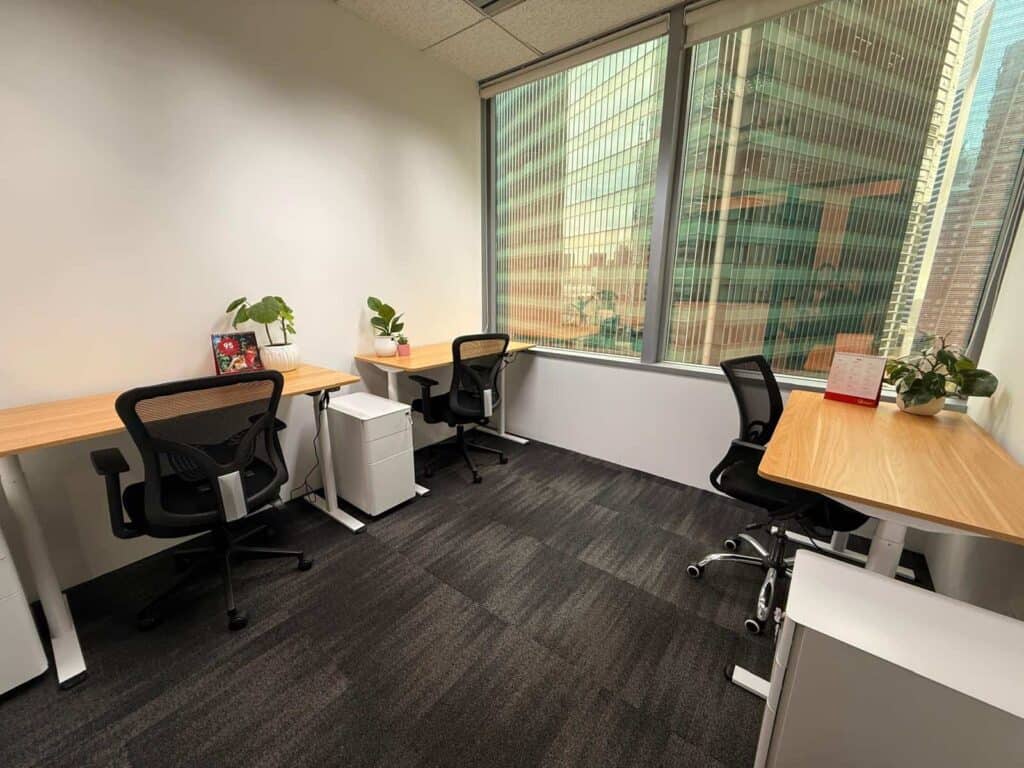
In advisory work, confidentiality is currency. Sensitive calls, negotiations, candidate discussions, and pricing reviews require a closed door.
A private serviced office gives your team the ability to handle these moments without improvisation. When the door closes, focus increases. When focus increases, errors drop. The effect is subtle, but it shows up in the speed and quality of decisions.
For teams mapping growth, privacy also supports better management cadence. Reviews, one-to-ones, and performance conversations happen properly, without the social friction of conducting important discussions within earshot of strangers.
Reception Standards That Match Professional Services Expectations
Clients may not say it, but they notice. The lift lobby. The reception welcome. The way meeting rooms are prepared. The quiet competence of the environment.
Front-of-house standards influence perceived risk. When a client is choosing advisers, they are also choosing judgement. A well-run serviced office supports that judgement with small, consistent signals: spotless shared areas, reliable meeting room experience, and a professional welcome that does not feel improvised.
For Singapore teams building credibility in competitive sectors, that consistent experience can be the difference between "capable" and "trusted" in the client's mind.
Prestige And Convenience: Why CBD Addresses Still Matter In Singapore
In Singapore, the address still does work on your behalf.
There are rational reasons for this. Grade A central business district supply remains constrained, and expectations of tighter vacancy and stronger rental growth have reinforced the long-standing appeal of core locations. Decentralised areas have their place, particularly for cost optimisation, but many established teams prefer a headquarters that anchors client perception and staff convenience.
A serviced office in the central business district is a way to access that prestige without treating the office lease as an inflexible macro bet.
Client Confidence, Talent Attraction, And Reduced Commute Friction
Client confidence is often built before the meeting begins. A central location with a recognised business address reduces friction. It is easier to find, easier to justify, and easier to interpret as a signal of permanence.
Talent attraction is similarly practical. When a candidate weighs two offers, commute time becomes a quiet tie-breaker, particularly for mid-career professionals balancing family and workload. The daily experience matters. It is one reason serviced offices near Tanjong Pagar and Raffles Place appeal to growing teams: the East–West Line, the food scene and a core CBD address are all within a few minutes' walk.
Scalability Without Disruption: Grow Or Consolidate With Minimal Downtime
Every leadership team wants growth. Few want the disruption that often accompanies it.
In a conventional lease, scaling frequently means renegotiation, relocation, or awkward subletting. Those are not just property issues: they become operational distractions that land on senior staff at exactly the wrong time.
A serviced office offers a more measured way to scale. You can treat space as a dial rather than a cliff edge.
Adding Offices, Meeting Rooms, Or Project Space As Needs Change
Growth does not always come as permanent headcount. Sometimes it is a project team for three months, a new business line in pilot mode, or a regional lead who needs a private room and a dependable base.
With flexible workspace, you can add offices, meeting rooms, or temporary project space without a construction schedule and without dismantling your existing rhythm.
It also works in the other direction. When a team consolidates, the ability to reduce footprint without a drawn-out exit process protects cash flow and keeps morale steady. Stability is not only about expansion: it is about having control when conditions change.
A Practical Evaluation Checklist Before You Commit
Not all serviced offices are equal, and directors should evaluate them with the same discipline used for any long-term operating decision.
A good operator makes the complex look simple.
What To Compare: Agreement Terms, Inclusions, Security, And IT Resilience
When we evaluate a serviced office for our own operations, we treat it as a risk and performance assessment, not a facilities purchase. The checklist below reflects what tends to matter once the novelty fades and the day-to-day reality begins.
Agreement and flexibility
- Notice periods and renewal options that match hiring uncertainty
- Clear policies on adding or reducing space
- Transparent treatment of deposits and liabilities
Inclusions and true total cost of ownership
- What is genuinely included versus "available at cost"
- Meeting room allocations and overage rates
- Printing, pantry, and after-hours air-conditioning policies
Security and confidentiality
- Physical access controls, visitor handling, and closed-door privacy
- Clear demarcation of private areas versus shared areas
Information technology resilience
- Redundant connectivity options and response times
- On-site support capability, not only outsourced helpdesk
- Sensible network segregation for professional services needs
Building and receiption standards
- Reception experience for clients
- Meeting room quality and availability during peak periods
- Maintenance response time that keeps the office feeling "run well"
If your priority is employee retention and focus, it is also worth considering the psychological impact of private space. We have seen teams underestimate this until they experience it, and our observations align with what we discuss in how private serviced offices support satisfaction and concentration.
A final note: treat the tour like a due diligence visit. Ask to see how issues are handled, not only how the space photographs. The operational truth is usually in the small details.
Conclusion
Serviced offices are being chosen more often in Singapore because they align with how established businesses actually operate: cautiously optimistic, alert to volatility, and unwilling to trade professional image for flexibility.
When the market is uncertain, the strongest position is often the one that preserves options without sacrificing standards. For many teams, that means a private, central business district headquarters that is ready immediately, priced transparently, and able to scale without drama. The strategic win is not novelty. It is control. We cover a list of business types that typically operate in a serviced office.
Frequently Asked Questions
Why are Singapore teams choosing serviced offices instead of a traditional office lease?
Many Singapore teams are choosing serviced offices to avoid the risk and hidden costs of long, rigid leases in a volatile market. A serviced office offers a private, client-ready HQ with predictable monthly outgoings, fewer upfront commitments, and flexibility to expand or consolidate without a disruptive relocation. A serviced office in raffles quay chosen over a traditional office rental highlights a crucial decision for many companies. The ability to scale operations quickly and adapt to changing business needs makes serviced offices increasingly attractive. As teams prioritise agility, the advantages of flexibility in a serviced environment become even clearer.
How do serviced offices in Singapore help with hiring and headcount planning?
Instead of locking into a fixed footprint, teams can add rooms or adjust capacity in line with actual recruitment cycles, project peaks, or temporary teams—without months of empty desks or rushed expansions.
Are serviced offices cheaper when you compare total cost of ownership?
Often, yes—once you include total cost of ownership. Traditional leases can look cheaper per square foot, but add fit-out spend, vendor management time, IT setup, delays, and end-of-lease reinstatement exposure. A serviced office bundles these into predictable pricing, reducing costly surprises and management distraction.
Do serviced offices provide enough privacy and professionalism for client-facing work?
Premium serviced offices are designed to function as a real headquarters, not a hot-desk environment. Private offices, enclosed meeting rooms, controlled access, and a professional front-of-house help advisory, legal, recruitment, tech, and finance teams handle sensitive calls and client meetings confidently and discreetly.
Why does a CBD address still matter when choosing a serviced office in Singapore?
A CBD address can improve client confidence, signal credibility, and reduce friction for meetings. It also supports talent attraction by cutting commute pain for mid-career hires. With Grade A CBD supply tight and rents expected to stay firm, serviced offices provide access to prime locations without long lease risk.
What should I check before signing a serviced office agreement in Singapore?
Treat it like due diligence: review notice periods, renewal options, and clear rules for adding or reducing space. Confirm what’s truly included (meeting rooms, after-hours air-con, printing), assess security and visitor handling, and test IT resilience (redundant connectivity, on-site support, network segregation).


Has anyone had a direct comparison between the costs of a serviced office versus a traditional lease? The section on avoiding fit-out CapEx is intriguing, but some real-world numbers would help make the decision clearer for small businesses like mine.
Oliver, from my experience, the initial savings on fit-out costs with serviced offices are significant, especially if you’re unsure about long-term business location commitments. However, monthly costs can add up, so make sure to calculate your long-term budget.
The impact of lease rigidity on hiring and headcount planning can’t be understated. It’s been a real challenge for us to align our office space with our growth projections, and serviced offices might just be the solution we need.
Really appreciate the insight on privacy and professionalism in serviced offices. Having a proper place for client calls and sensitive work without committing to a traditional office lease is a game-changer for startups.
Regarding scalability without disruption, it’s crucial for freelancers and consultants who have fluctuating needs. Being able to adjust the workspace according to current projects without the hassle of moving or long-term commitments is invaluable.
CBD addresses still matter a lot! Client confidence and talent attraction are key for marketing agencies. This piece perfectly highlights why location is still a significant factor, even in the digital age.
The checklist before committing to a serviced office is a useful tool. Would you say security and IT resilience are more or less critical than the terms and inclusions in the agreement? Thanks for the comprehensive insights, Nat.
Why are CBD addresses still considered prestigious and convenient given the shift towards remote work? Do you think this perception will change over time or remain an enduring value for businesses in Singapore?