

Introduction
Types of office spaces in Singapore have multiplied considerably over the past decade, and for the founder, managing director, or country manager weighing a property decision, this proliferation is both an opportunity and a source of considerable strategic risk.
Industry data from CBRE and Cushman & Wakefield consistently indicates that Grade A office rents in the Central Business District remain among the highest in the Asia-Pacific region, with capital expenditure on a typical bare-shell fit-out frequently exceeding fifty thousand Singapore dollars before a single member of staff occupies a desk. For an established small-to-medium enterprise of five to twenty professionals, or a regional branch of a multinational corporation, that financial commitment represents a meaningful diversion of capital away from revenue-generating activity.
The traditional three-year lease, once the unquestioned default for any serious professional services firm, has come under sustained scrutiny. Hybrid working patterns, fluctuating headcount projections, and the volatile demand cycles affecting legal practices, recruitment consultancies, technology firms, and management advisories have rendered long-tenure commitments uncomfortably rigid. Decision-makers find themselves negotiating reinstatement clauses, juggling utility providers, supervising cleaning rosters, and chasing internet service providers, all of which constitute administrative overhead with no direct contribution to billable output or client acquisition.
This guide examines the principal types of office spaces in Singapore through the lens of stability, agility, prestige, and return on investment. The objective is not to advocate for any single format, but to provide the analytical framework an executive requires to match a workspace solution to the operational realities of an established professional services business. Whether the priority is a prestigious Central Business District address for client-facing meetings, the agility to scale headcount across a market cycle, or the simple removal of administrative friction, the workspace category selected should reinforce business stability rather than undermine it.
What an Office Space Means for the Modern Professional Services Firm
An office space, in its functional sense, is a dedicated environment configured for desk-based professional work. It encompasses the physical premises, the connectivity infrastructure, the meeting and conference facilities, and the ancillary services that allow a team to operate productively. For the audience this guide addresses, however, an office space is rather more than the sum of its furnishings.
For a legal practice negotiating sensitive commercial matters, the office is a controlled environment in which client confidentiality is preserved through closed-door privacy. For a recruitment firm, it is the stage upon which candidate interviews and client briefings unfold, and the address printed on the proposal carries weight in the eyes of corporate counterparties. For a technology consultancy, it is the operational headquarters from which engagements are managed, and where the firm's brand identity is conveyed to visitors. The office, in short, is an instrument of business stability and reputational positioning.
The shift toward hybrid working has not diminished this requirement; if anything, it has refined it. Where once a firm needed to accommodate the entire workforce at once, the contemporary expectation is that the office will function as a hub for collaboration, client engagement, and confidential discussion, supplemented by remote working for routine tasks. The implication for property decisions is significant: the question is no longer how much space a firm must lease, but rather what configuration of space will deliver the highest return on each square foot occupied.
The Different Types of Office Spaces in Singapore
The Singapore market presents a considered range of workspace categories, each addressing a distinct combination of cost structure, lease commitment, and operational support. The following sections examine each category in turn, with attention to the practical considerations that bear upon an executive evaluation.
Traditional Leased Office Spaces
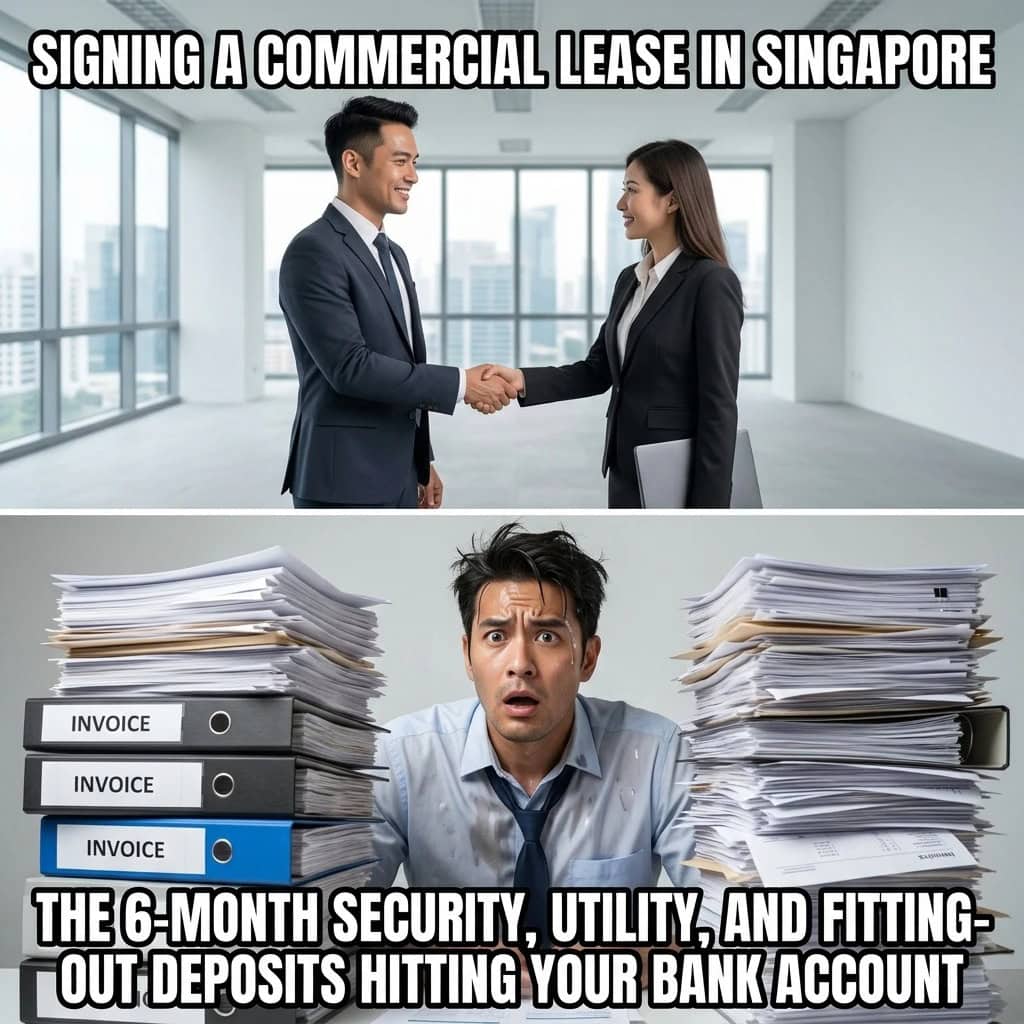
The traditional leased office remains the conventional choice for firms that have reached a settled scale and require complete control over their physical environment. Under this arrangement, the business secures a unit directly from a landlord or through a leasing agent, typically on a tenure of three years or longer, and assumes responsibility for fit-out, furnishing, utilities, telecommunications, cleaning, and reinstatement at the end of the term.
The appeal is straightforward: the firm exercises full authority over the premises, may brand the space as it sees fit, and benefits from the prestige of an exclusive address. The corresponding burden is equally straightforward: capital expenditure on fit-out can run into six figures for a modest unit, the lease commits the business to a fixed cost regardless of headcount fluctuations, and the administrative load of running the premises falls entirely upon the firm. For an established legal partnership of fifteen with a stable client book and predictable revenue, this calculus may make sense. For a recruitment firm anticipating cyclical hiring waves, or a technology consultancy whose engagement portfolio shifts with each fiscal quarter, the rigidity may prove costly.
Serviced Offices
The serviced office category is purpose-built for the executive who requires a fully operational headquarters from the first day of occupancy. Our serviced offices at 6 raffles quay are private, fully furnished, enclosed units within a managed building, and the membership fee bundles together the rent, utilities, internet, reception services, cleaning, and access to meeting rooms. The business walks in, plugs in, and commences work, with no separate vendor relationships to manage.
For the audience this guide addresses, the serviced office addresses three core pain points directly. The capital expenditure typically associated with a bare-shell fit-out is eliminated entirely. The administrative burden of overseeing utility bills, cleaners, and internet service providers is removed from the executive's plate. The lease term, customarily ranging from three to twenty-four months, is meaningfully shorter than a traditional commercial tenancy, providing the agility to scale up or contract as circumstances dictate.

Our serviced offices in prestigious Central Business District locations also confer the address-based credibility that matters when a senior counsel or a corporate counterpart receives a meeting invitation. For directors evaluating Grade A options in the heart of the financial district, our serviced offices at 6 Raffles Quay place the business within walking distance of Raffles Place MRT, the principal financial institutions, and the courts, with current availability for teams seeking immediate occupancy.
The trade-off, such as it is, lies in the standardisation of the environment. While our serviced offices accommodate a degree of personalisation, the level of bespoke branding available within a traditional fit-out is, by design, more constrained. For most professional services businesses, this is a price worth paying for the elimination of capital risk and administrative friction.
Coworking Spaces
Coworking spaces in Singapore represent a distinct workspace category, typically configured as shared environments within a managed building. The popular conception of coworking conjures images of open-plan benches and casual networking, but the category in practice spans a wider spectrum.
Our coworking space in 6 Raffles Quay, for instance, is configured as a shared suite with multiple dedicated desks, accommodating up to three members within an enclosed setting. This format suits a small founding team, a satellite office for a growing branch, or a project-based working group that requires more privacy than a hot desk affords but does not yet warrant a fully private office. Members of our coworking space gain access to meeting rooms, lounges, and the broader services of the building, while operating within a defined and predictable environment.
For the SME founder weighing options, the coworking format offers the lowest barrier to entry in terms of monthly commitment, while still providing a credible working environment. It tends to suit firms in the earliest phase of establishment, those operating under tight cost discipline, or those testing a market presence before committing to a larger footprint.
Virtual Offices
A virtual office provides the legal and reputational infrastructure of a Central Business District address without the physical occupancy. Members receive a registered business address, mail handling and forwarding services, and, where required, occasional access to meeting rooms for client engagements. The format is well suited to consultancies operating predominantly from client sites, foreign entities exploring the Singapore market before establishing a permanent presence, and solo practitioners whose work is conducted remotely.
The principal advantage is the prestige of a recognised address at a fraction of the cost of physical occupancy. The principal limitation is the absence of a permanent workspace, which may not suit firms whose operations depend upon regular in-person collaboration or confidential client meetings.
Private Offices Within Flexible Workspace Buildings
A private office within a flexible workspace building combines the privacy and security of an enclosed unit with the operational convenience of a managed environment. The format is, in effect, a sub-category of the serviced office model, with the same bundled-services proposition, but typically positioned for slightly larger teams or firms that prioritise full enclosure over the more open configurations available within coworking suites.
For a legal practice handling matters that demand strict confidentiality, or a recruitment firm conducting candidate interviews on a regular basis, the private office offers the closed-door environment that the work demands, without imposing the capital and administrative burdens of a traditional lease.
Enterprise Suites
Enterprise suites are larger, customisable office configurations within flexible workspace buildings, designed for established businesses requiring twenty or more desks. The format permits a meaningful degree of bespoke branding and layout, while preserving the bundled-services and shorter-tenure structure of the broader flexible workspace model. Enterprise suites are particularly relevant for branch offices of multinational corporations seeking the operational autonomy of a dedicated floor, without the entanglements of a direct lease.
Shophouse Offices
Shophouse offices occupy restored heritage buildings in central districts such as Tanjong Pagar, Telok Ayer, Amoy Street, and Joo Chiat. These boutique spaces blend architectural character with functional working environments, and tend to appeal to creative agencies, design consultancies, and boutique advisory firms whose brand identity benefits from a distinctive setting. The cost structure varies, but the supply is necessarily limited by the availability of conserved buildings, and the operational profile typically resembles a traditional lease rather than a flexible arrangement.
Business Parks
Business parks are purpose-built campuses located outside the Central Business District, accommodating a mixture of office and light industrial activity. Singapore's principal business park locations include One-North, Changi Business Park, the International Business Park in Jurong, and Seletar Aerospace Park. These environments offer larger floor plates and integrated facilities at rents below those of the city centre, and tend to suit firms in research and development, technology, logistics, and manufacturing-adjacent professional services. For a firm whose client base does not require frequent Central Business District meetings, the cost differential can be material.
Industrial and Commercial Hybrid Units (B1/B2)
Industrial office spaces, classified under Singapore's B1 and B2 zoning categories, accommodate a combination of administrative and light industrial functions within a single unit. Located in areas such as Ubi, Tai Seng, and Bukit Batok, these hybrid spaces are typically priced below conventional commercial premises, but are subject to Urban Redevelopment Authority restrictions on the proportion of pure office use permitted. The format is appropriate for e-commerce operators, hardware-oriented technology firms, and businesses requiring on-site storage or workshop capacity.
Office Building Grades in Singapore
The grading classification of Singapore's office buildings provides a further dimension to the property decision. The categorisation is widely used by property professionals and merits the attention of any executive evaluating workspace options.
Grade A buildings represent the upper tier of the market: modern construction, premium specifications, prestigious Central Business District locations, and high-quality services and amenities. Examples include Marina One, OCBC Centre, and developments in the Marina Bay precinct, alongside established towers such as 6 Raffles Quay within the Raffles Place financial corridor. Rental rates are correspondingly elevated, but the address signals scale and stability to clients and counterparties.
Grade B buildings tend to be older, well-maintained properties in fringe Central Business District locations or in established commercial corridors. Rents are moderately lower than those of Grade A premises, and the buildings remain entirely suitable for professional services firms that prioritise functional efficiency over signature address.
Grade C buildings are typically older developments in less central locations, offered at significantly lower rents. While the cost economics may appeal, the environmental and reputational considerations should be weighed carefully against the savings.
Comparing Coworking Spaces and Traditional Offices
For the executive weighing a flexible workspace solution against a conventional lease, the following comparison sets out the principal distinctions:
| Coworking and Flexible Workspace | Traditional Leased Office |
|---|---|
| Membership terms typically range from one month to twenty-four months | Lease commitments commonly extend to three years or beyond |
| Bundled access to meeting rooms, lounges, and shared facilities | Dedicated, exclusive use of the entire premises |
| Suited to growing professional services firms requiring agility | Suited to established firms with stable headcount projections |
| Encourages incidental networking with neighbouring businesses | Permits comprehensive control over layout, branding, and culture |
| Capital expenditure is minimal; furniture and fit-out are included | Significant upfront capital expenditure on fit-out and furnishing |
| Accommodates hybrid and flexible working arrangements with ease | Fixed configuration supports consistent daily routines |
| Round-the-clock building access at most flexible workspace operators | Operating hours typically aligned with standard business windows |
| Building management handles utilities, maintenance, and cleaning | Full operational responsibility rests with the firm |
The decision between the two formats turns less upon abstract preference and more upon the firm's stage of development, its tolerance for capital commitment, and its appetite for administrative oversight. For most established small-to-medium enterprises and branch offices in professional services, the flexible workspace model offers the more favourable balance of risk and operational efficiency.
Factors Executives Should Consider When Evaluating Office Spaces in Singapore
A workspace decision is, at its core, a capital allocation decision. The framework below outlines the principal factors that warrant careful consideration.
Total Cost of Occupancy
The headline rental figure, while important, is rarely the most informative metric. A more accurate evaluation aggregates the rent, the fit-out amortisation, the utilities, the telecommunications, the cleaning and maintenance, the reinstatement provision, and the administrative time required to oversee these matters. A flexible workspace solution may carry a higher headline rate per square foot, yet deliver a lower total cost of occupancy when these ancillary expenses are properly accounted for.
Location and Address
The address printed on a proposal or business card carries reputational weight, particularly in client-facing professional services. A Central Business District address in Raffles Place, Shenton Way, or Marina Bay signals scale and stability, while a peripheral location may raise unnecessary questions in the mind of a prospective client. Beyond reputation, location affects the daily commute of staff, the convenience of client meetings, and the proximity to courts, regulators, and key counterparties.
Lease Tenure and Flexibility
The lease term should align with the firm's planning horizon. A three-year commitment makes sense when revenue projections are stable and headcount is predictable; it becomes a liability when the market is volatile or when the business is in a growth phase. A flexible workspace solution permits the business to adjust its footprint in response to actual circumstances, rather than projected ones.
Scalability and Headcount Adaptability
A workspace solution should accommodate both expansion and contraction. The ability to add or release desks without renegotiating the underlying contract is a meaningful operational advantage, particularly for recruitment firms, consultancies, and other professional services businesses whose staffing levels move with project flow.
Privacy and Confidentiality
For legal practices, financial advisories, and recruitment firms, the ability to conduct confidential conversations behind closed doors is non-negotiable. The workspace evaluation should examine the availability of private offices, sound-attenuated meeting rooms, and discreet client reception arrangements.
Operational Support and Service Quality
The quality of reception, IT support, mail handling, and facilities management has a direct bearing upon the executive's ability to focus on revenue-generating activity. A workspace operator with a proven track record in service delivery removes a significant source of administrative drag from the leadership team.
Top Locations in Singapore for Office Spaces
Singapore's commercial geography offers distinct precincts, each with its own character and tenant profile. The following overview is intended as a starting point for executives evaluating location options.
The Raffles Place and Shenton Way corridor is the historic financial heart of Singapore, accommodating the principal banking institutions, law firms, and professional services advisories. Grade A towers dominate the skyline, including buildings such as 6 Raffles Quay, where our serviced offices currently offer availability for businesses seeking an immediate Central Business District presence. The address carries unmistakable prestige.
Marina Bay represents the more recent expansion of the Central Business District, with landmark developments such as Marina One and Marina Bay Financial Centre offering premium floor plates to multinational corporations and large professional services firms.
Orchard Road combines premium retail with selective office accommodation, and tends to suit luxury brands, marketing agencies, and design firms seeking a stylish address with strong consumer-facing visibility.
Bugis and Bras Basah have emerged as creative and technology-oriented districts, with a growing supply of coworking spaces and flexible workspace solutions appealing to startups, small-to-medium enterprises, and professional services firms with a creative orientation.
One-North is the principal innovation precinct, accommodating research and development, technology firms, and biomedical sciences operators within a purpose-built environment.
Tampines and Changi offer business park and serviced office options at more accessible price points, suiting logistics operators, light industrial businesses, and corporate branch offices comfortable operating outside the city core.
The broader Central Business District encompasses a mixture of Grade A, Grade B, and flexible workspace options, providing executives with meaningful choice across price points and building specifications.
Frequently Asked Questions About Types of Office Spaces in Singapore
What are the main types of office spaces available in Singapore?
The principal categories include traditional leased offices, serviced offices, coworking spaces, virtual offices, private offices within flexible workspace buildings, enterprise suites, shophouse offices, business parks, and industrial-commercial hybrid units classified under B1 and B2 zoning. Each category addresses a distinct combination of cost, flexibility, and operational support.
Are serviced offices suitable for established small-to-medium enterprises?
Serviced offices are particularly well suited to established small-to-medium enterprises and branch offices, given the elimination of capital expenditure on fit-out, the bundled administrative services, and the shorter lease tenures, which together preserve agility while delivering a fully operational headquarters from the first day of occupancy.
How much does an office space typically cost in Singapore?
Costs vary substantially according to location, building grade, and workspace category. Prime Central Business District addresses such as Raffles Place and Marina Bay command premium rates, while peripheral locations and business parks offer materially lower price points. Flexible workspace solutions in Central Business District buildings typically commence from approximately seven hundred Singapore dollars per desk per month, while suburban locations begin from around five hundred Singapore dollars.
What is the standard space allocation per employee in Singapore?
Industry benchmarks suggest an allocation of approximately one hundred to one hundred and fifty square feet per employee, encompassing the workstation, an apportioned share of meeting rooms, and communal areas. The actual requirement varies according to the nature of the business and the working pattern adopted.
What is the difference between a coworking space and a serviced office?
A coworking space is typically a shared environment in which members occupy desks within a larger suite, often alongside other businesses, and benefit from communal amenities. A serviced office is a fully enclosed, private unit reserved for a single business, providing closed-door privacy and a higher level of bespoke service. Both formats share the bundled-services and flexible-tenure structure of the broader flexible workspace model.
How long are typical flexible workspace agreements in Singapore?
Flexible workspace agreements commonly range from one month to twenty-four months, with most established operators offering a sliding scale of commitment. This contrasts sharply with traditional commercial leases, which typically run for three years or more.
Can a serviced office accommodate confidential client meetings?
A serviced office is purpose-built for confidential business activity. Our serviced offices feature enclosed, soundproofed environments, and the buildings provide bookable meeting rooms with appropriate privacy specifications for sensitive client engagements.
What administrative services are typically included in a flexible workspace agreement?
A standard flexible workspace agreement bundles together the rent, utilities, high-speed internet, cleaning, maintenance, reception services, and access to meeting rooms. Additional services such as mail handling, IT support, and event spaces are commonly available, either as part of the core agreement or as optional enhancements.
Are there flexible workspace options available in Raffles Place?
Raffles Place offers a meaningful concentration of flexible workspace inventory across its Grade A towers. Our serviced offices at 6 Raffles Quay, for instance, currently have availability for businesses seeking a prestigious financial district address with immediate occupancy and the full complement of bundled services.
How does a virtual office differ from a coworking membership?
A virtual office provides a registered business address, mail handling, and occasional access to meeting facilities, but does not include daily physical occupancy. A coworking membership, by contrast, provides regular access to a physical workspace, alongside the building's amenities. The two formats serve distinct operational requirements and may, in some cases, be combined.
Closing Reflections
The proliferation of types of office spaces in Singapore reflects a market that has matured considerably in response to the operational realities of contemporary professional services. For the established small-to-medium enterprise founder, the branch managing director, or the country manager weighing a property decision, the contemporary landscape offers meaningful choice, but it also demands careful evaluation. The traditional default of a three-year commercial lease no longer commands the unquestioned authority it once held, and the executive who scrutinises the full cost of occupancy, the administrative burden, and the implications of lease rigidity will frequently conclude that a flexible workspace solution delivers a more favourable balance of risk, cost, and operational efficiency.
The right workspace decision is the one that reinforces business stability, preserves capital for revenue-generating activity, and provides the agility to respond to market conditions as they unfold. Whether the conclusion is a serviced office in a Grade A Central Business District tower, a coworking suite for a growing team, or an enterprise solution for a regional branch operation, the framework set out in this guide should equip the decision-maker to evaluate the options on a basis that reflects the seriousness of the commitment.


This article clearly outlines the challenges of choosing office space in Singapore. The costs can definitely be overwhelming for SMEs.
I found the points on hybrid working particularly relevant. Many firms are grappling with this shift. What kind of office arrangements do you think work best for smaller teams?
I believe a mix of co-working spaces and traditional leases might be best. This way, SMEs can scale as needed without heavy commitments.
As someone who recently started a business, I appreciate the insights on serviced offices. They seem like a great option to avoid heavy upfront costs.
It’s interesting how office spaces are becoming hubs rather than just places to work. Do you think we’ll see more flexible plans in the future?
Absolutely! Flexibility is key these days. Companies want to adapt quickly without being tied down by long leases.
The emphasis on costs versus benefits is spot on. Too many companies underestimate ongoing expenses on maintenance.
Great read! I never realized how much goes into leasing an office. The financial commitment can really keep a business from growing.
The section about confidentiality for legal practices made me think. How do firms balance security and collaboration in hybrid setups?
It’s tricky! I guess firms need to invest in secure tech while creating spaces that encourage teamwork.
It would be good to have more examples of companies successfully using flexible office spaces. Any case studies?
Thank you for sharing this guide, Wilson. It’s a timely reminder for many SMEs to rethink their office needs as the market evolves.