Coworking at 7-Eleven (4 Robinson Road) is a phrase nobody behind the counter would recognise. The seats along the window were installed for customers eating instant noodles, yet for most of the working day they sit empty, cooled, fitted with power outlets beneath the table, and a minute from the lobbies where much of this city's professional business is conducted.

Directors notice such things, because the arithmetic behind workspace in Raffles Place is rarely far from mind.
Fitting out a bare-shell unit in the Central Business District routinely swallows fifty thousand dollars or more before a single member of staff has taken a seat, and that capital is committed years before anyone can say with confidence whether the team will number six people or sixteen. Add the quiet erosion of management time spent chasing utility accounts, cleaning contractors and internet providers, then set the whole arrangement inside a three-year lease signed in one market and honoured in another, and the appeal of something lighter becomes obvious.
That preference for something lighter is what puts a director at a convenience store table between two appointments. A store at the foot of an office building, cooled and open for most of the day, holds up surprisingly well for the forty minutes between a meeting in Shenton Way and a signing at Collyer Quay.
This is not a hypothetical for me. In an earlier role, a good part of my week was spent out on the move between appointments, and I was forever hunting for the same two things: somewhere clean to sit, and somewhere to charge my devices before the next job.
A convenience store with an empty table and a socket under it answered both, and it did so without a booking, a membership or a bill at the end of the month. That habit is what first sent me looking at the seats in this particular store with a working eye.
What follows is a first-hand account of the 7-Eleven at the House of Eden, written for the executive who wants the practical details set out plainly rather than dressed up.
I will describe what the seating actually offers, where the store falls short of a working environment, and how our coworking space at raffles quay and our serviced offices answer the limitations that a convenience store table was never designed to address.
What Coworking at 7-Eleven (4 Robinson Road) Actually Means
The phrase promises more than the store set out to provide. There is no booking system, no membership, no day pass and no reception desk. Coworking at 7-Eleven (4 Robinson Road) describes something plainer: you buy something from the store, take one of the dining seats near the shopfront, and get a short piece of work done in comfort.
The arrangement is informal and unmanaged, and it depends entirely on the goodwill of a retailer whose business is selling food, not renting desks.
The nearest comparison is a hot desk, though even that flatters it.
A hot desk in a commercial venue at least carries an expectation of privacy, connectivity and a paid-for stretch of time. Here you have a flat surface, a chair, cool air and whatever legitimacy a receipt confers. For certain tasks that is enough; for others it is nowhere near.
Why the House of Eden Store Draws Professionals in Raffles Place
The House of Eden is a twelve-storey commercial building on Robinson Road with a floor plate of roughly three and a half thousand square feet, sitting squarely in District One among the law firms, recruitment consultancies and branch offices that populate this stretch of the city.
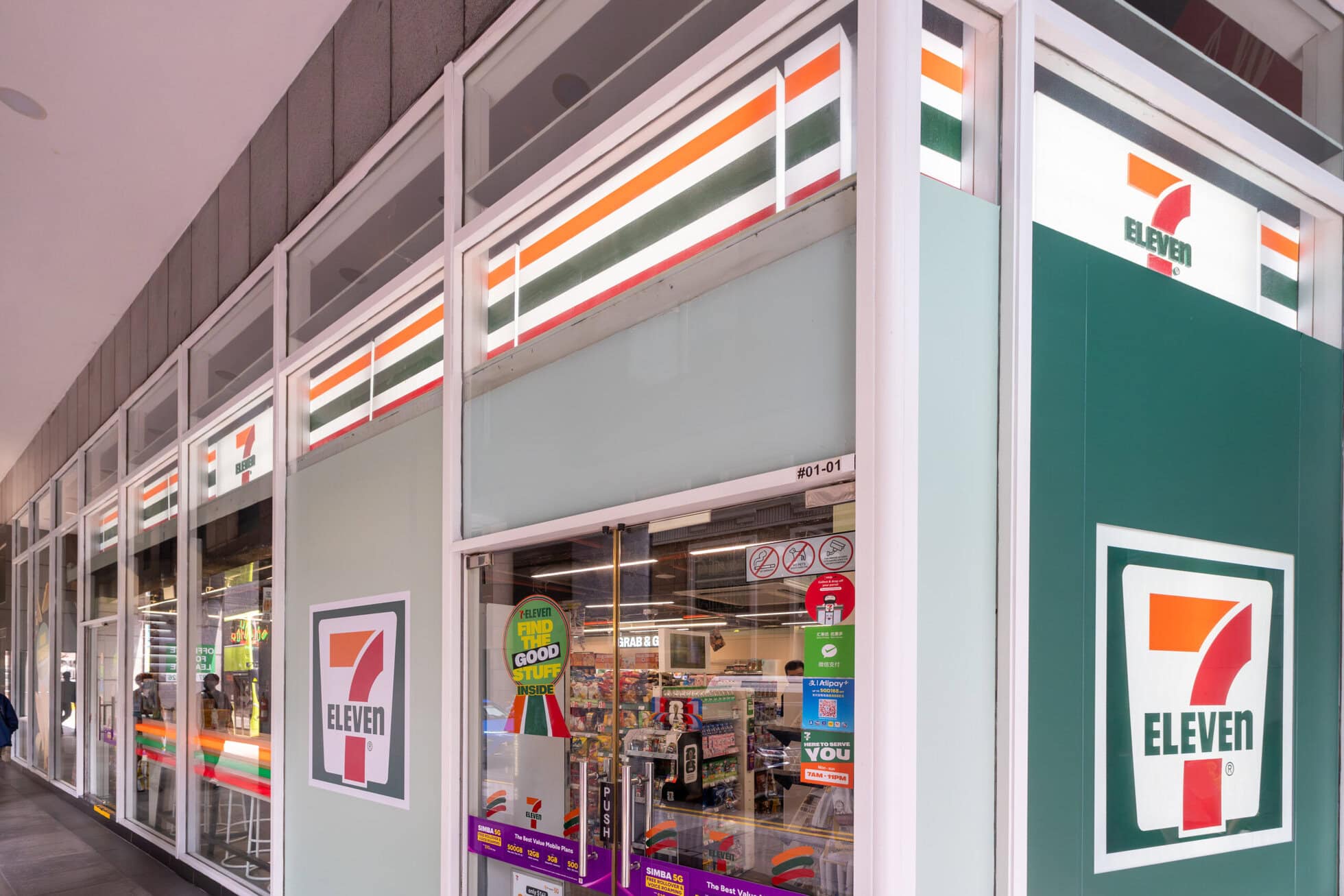
The 7-Eleven occupies the ground floor unit, behind floor-to-ceiling glass, and it is noticeably larger than the typical neighbourhood outlet.
Location explains most of its usefulness.
Walk out of the store and you are minutes from One Raffles Quay, Prudential Tower and the banking halls where a great deal of professional business is transacted.
When a meeting finishes early and the next one is across the road, the alternatives are unattractive: a café where the queue costs you fifteen minutes and a table is not guaranteed, a hotel lobby where the seating is arranged for conversation rather than for a laptop, or a return journey to your own premises that consumes more time than the gap you are trying to fill.
Against that field, a quiet table thirty seconds from where you are standing has an obvious claim on your attention.
Getting There and Planning Your Arrival

The store sits at 4 Robinson Road, Singapore 048543, on the ground floor of the House of Eden.

Raffles Place station on the Mass Rapid Transit network is the nearest interchange, and Exit F brings you out within sight of the shopfront; a walk of roughly five minutes covers the distance from the main concourse at an unhurried pace. Several bus stops serve the immediate area, including the stop at One Raffles Quay and the stop opposite the tower on Robinson Road.
Opening hours have been published as seven in the morning until eleven at night, seven days a week, which is generous by the standards of a working day but not the round-the-clock arrangement found at some other outlets in the district.
Hours at individual stores are revised from time to time, so a quick check before you make a special journey is a sensible precaution, particularly if you are planning an early start or a late finish.
The Seating on the Ground Floor: Built for Dining, Useful for Short Tasks

The tables and stools along the window were installed for people eating instant noodles, a warmed pastry or one of the store's hot food items, and the signage above them makes that purpose entirely clear. There is a counter arrangement facing the street and a small cluster of seats within the store, and the whole area carries the cheerful branding of a rest stop rather than an office.
On every occasion I have passed through, the seats have been largely empty. Convenience store dining in this part of town comes in bursts around the lunch hour, and outside those bursts a well-lit, air-conditioned table facing Robinson Road sits unclaimed.
For a director with forty minutes to spare and a document to review, that empty table costs the price of a coffee and a sandwich. The food is part of the point, too. When the next appointment is at two o'clock and lunch has quietly slipped off the schedule, eating while you clear your correspondence is worth something on its own.
Purchase Something Before You Sit Down
Courtesy here is also a matter of house rules. The seating belongs to the store and is meant for customers eating what the store sells. Signage at the tables asks visitors not to bring in outside food and drinks, requests that alcohol be taken away rather than opened on the premises, and reminds everyone to leave the table clean for the next person. Clearing your own table is standard practice in Singapore wherever you have paid at a counter, and a convenience store is no exception.
My own approach is simple: buy a proper meal or at least a hot drink, keep the receipt, take one seat rather than spreading across three, and tidy up before leaving. A store that lets a working professional sit at a quiet hour is extending a courtesy, and the fastest way to see that courtesy disappear across the network is for people to start treating it as their due. Spending a few dollars keeps the seat available to whoever needs it next.
Connectivity: Bring Your Own Hotspot
This is the detail most likely to derail an otherwise sound plan. Unlike the public library network, which is covered by the national wireless service, I found no Wireless@SG signal at this location. Anyone intending to work here needs a personal mobile hotspot, and should pack it as standard equipment rather than a backup.
For most executives this presents no real obstacle, since a corporate mobile plan with a reasonable data allowance handles a browser, a mail client and a cloud document without complaint. The caution concerns everything beyond that. Tethered connections in a ground floor retail unit surrounded by concrete and glass can be uneven, and a file transfer of any size will consume both data and patience. It is also worth remembering that a mobile hotspot in a public retail space is a shared radio environment, which is a consideration for anyone handling client material subject to confidentiality obligations. Where security genuinely matters, a properly managed network is not a luxury, and our information technology infrastructure exists for exactly that reason.
Power Outlets Beneath the Tables
Electricity is the happier surprise. Power outlets are fitted beneath the tables, so a laptop running low at half past three does not force you out of your seat. Anyone who has hunted for a free socket in a crowded café knows how much that changes about a table.
Two things are worth knowing. Sockets under a table are easy to miss, so glance beneath the surface before you settle in rather than move seats later, and keep any cable clear of the walkway, since a trailing lead in a busy retail unit is a hazard to shoppers and to your own equipment alike. A short cable, or one run close to the table leg, keeps things tidy. Bring your own adapter as well, because you cannot count on a particular socket being free at the hour you arrive.
The Second Level and the Coca-Cola Lounge: A Cautionary Note
This store earned a considerable amount of attention when it opened as a collaboration between 7-Eleven and Coca-Cola, and the second floor was the reason.
A red staircase led up to a lounge fitted with seating, sofas, bean bags, tables styled after an American diner, charging points, a foosball table and claw machines dispensing prizes for customers who spent a qualifying amount downstairs. Read the coverage from the launch period and it sounds close to an informal breakout space in the middle of the financial district.
My experience does not match those reports.
On each occasion we have visited the premises, the second floor has appeared closed, and I have not been able to establish whether the arrangement has ended permanently or is merely opened on a selective basis. I would therefore advise against building any plan around it. If you arrive expecting a lounge and find a staircase you may not use, the ground floor seating is what remains, and the ground floor seating is a rather different proposition.
Should you find the upper level accessible on your visit, treat it as a pleasant surprise rather than the reason for the journey.
The Work That Suits Coworking at 7-Eleven (4 Robinson Road)
The store does some things well, and it is worth being specific about which. Its strengths are proximity, availability and a near-total absence of commitment, and they suit short, self-contained work that lives entirely on a screen.
Reviewing a document before a meeting sits comfortably here. So does clearing a backlog of correspondence, checking that a proposal has landed with the client, approving an invoice, reading through a set of notes, drafting a short piece of writing, or preparing the two or three points you intend to raise upstairs in twenty minutes. During a longer wait, I have used the time for the sort of quiet administrative work that never quite finds a slot in a scheduled day and quietly accumulates until it becomes urgent.
My rule of thumb is this. If the task needs nothing more than a laptop, a connection and thirty to sixty minutes of my attention, the store does the job and does it conveniently. The moment it calls for my voice, another person, a confidential file on the screen or any certainty about how long I can stay, the setting turns against me, and no amount of goodwill from the staff will fix it.
Confidentiality Has No Place at a Convenience Store Table
For a legal practice, a recruitment consultancy or an advisory firm, this is where the matter ends. The seating faces the shopfront and the street, foot traffic passes within arm's reach, and the person who sits down beside you with a bowl of noodles has a clear view of your screen. Candidate records, draft agreements, client correspondence and commercially sensitive figures have no business being open in that setting, and a privacy filter reduces the risk without removing it.
The same applies to anything spoken aloud. Discussing terms on a telephone call in a retail unit means conducting your negotiation in front of an audience whose composition you do not control. Deals require closed doors, and this is the point at which the convenience of the location stops compensating for what it cannot offer.
Noise, Footfall and the Rhythm of a Retail Unit
A convenience store runs to its own rhythm, and that rhythm pays no attention to your concentration. Deliveries arrive, refrigeration units hum, the door chimes with every customer, the counter queue lengthens without warning around midday, and a store that felt calm at half past ten is a good deal noisier an hour later. That is simply what the space is for.
The consequence for planning is that the quality of the environment cannot be relied upon in advance. A workspace you pay for offers consistency as part of the bargain, and consistency is what allows a director to schedule the day with any confidence.
No Security, No Storage and No Safety Net
Nobody is watching your belongings. Stepping away to the washroom means either carrying a laptop and a bag with you or leaving equipment unattended among strangers in a public retail unit, and neither option is comfortable. Anything you leave behind is gone, with no reception desk to hold it and no colleague to telephone.
Nor is there any of the quiet infrastructure that a working day occasionally requires. There is no printer for the page that needs a signature, no locker for a folder of documents, no meeting room for the conversation that suddenly needs to happen in person, and no cupboard containing the charger you left at home. A single forgotten item can cost an hour, and an hour lost in the middle of a working day is rarely recovered.
Duration and the Courtesy of the Table
There is no stated time limit, which reads as freedom until you look closer. Because the seats are there for diners, how long you can reasonably stay is set by an unspoken expectation, not by anything you have paid for. Holding a table for four hours over a single coffee while the lunch crowd hunts for a seat is more than any retailer should be asked to tolerate.
In practice, treat the store as a facility for a defined interval of perhaps thirty to ninety minutes, ideally outside the busiest part of the day. That is a perfectly respectable use of a convenience store. It is not, on any reading, a base of operations, and a business that requires a base cannot be run from a seat it holds only by courtesy.
What Free Workspace Actually Costs a Business
Look past the price of the sandwich at the fuller bill. The saving is real but small. The costs are scattered and easy to miss: the meeting relocated at short notice, the call left unanswered because the setting made answering it awkward, the document that stayed shut because a stranger sat down beside you, the time lost trailing between venues in search of somewhere adequate.
Directors who weigh return on investment will know the shape of this from elsewhere in the business. An expense trimmed off one line has a way of turning up again, larger and harder to see, on another. None of this argues against using the store. It argues for being honest about which work belongs there, and for noticing the point at which improvising has started to shape your decisions rather than simply fill your gaps.
When Coworking at 7-Eleven (4 Robinson Road) Stops Serving Your Business
Set the strengths and the limits next to each other and the line is clear enough. The store handles a short, solitary, screen-based task in a convenient location, and it does so at almost no cost. It cannot hold a private conversation, receive a client who expects somewhere credible, carry a full working day, seat a team of any size, or keep a document from being read over your shoulder.
You tend to notice the threshold on a particular morning. It is the day you realise you have arranged your appointments around where you might sit rather than around what you need to get done, or the afternoon a client suggests meeting at your office and you hear yourself proposing a hotel lobby instead. By then the informal arrangement has stopped saving you anything and started holding you back, and stability is worth more to the business than the rent you were avoiding.
A Private Alternative Nearby: Our Coworking Space at Raffles Quay
Our premises stand at 6 Raffles Quay, a short walk from the House of Eden, which makes the comparison a practical one rather than a theoretical exercise. If you have tried working from the store, you already know the ground on which our coworking space is being offered.
What we offer is a deliberate departure from the open-plan floors the word coworking usually brings to mind. Our coworking space is a private shared suite with a small number of dedicated desks, up to three in total, so a desk is yours rather than something you claim afresh each morning. You can take a call without dropping your voice, leave your equipment out overnight, receive a visitor without apologising for the surroundings, and stay for as long as the day actually demands. You keep the focus a quiet corner gives you, and you lose the nagging question of whether you are still welcome. If you would rather see the numbers first, our comparison of office rental against a coworking space lays out the full cost picture across a year.
When a Serviced Office Becomes the Right Headquarters
For an established firm of five to twenty people, or for a branch office representing a larger group, the requirement is a headquarters rather than a seat. Our serviced offices are built for that need, and they answer the three anxieties that occupy most directors considering their next move.
The first is capital. Our serviced offices arrive fully furnished, connected and ready to occupy, so the sum that would otherwise disappear into a fit-out remains inside the business, where it earns a return rather than depreciating on a wall you may leave behind in eighteen months. The second is administrative drag. Utilities, cleaning, maintenance and connectivity are folded into a single arrangement, which removes a category of work that generates no revenue and consumes an unreasonable share of a director's week. The third is rigidity. We do not require the multi-year commitment that a conventional lease demands, so your space can follow the shape of your team as it grows or contracts, and scalability becomes a matter of a conversation rather than a legal negotiation. Closed doors for sensitive discussions, a Central Business District address that signals permanence to clients and candidates alike, and meeting rooms available when a conversation deserves a proper setting complete the arrangement.
Comparing a Convenience Store Table With a Professional Workspace
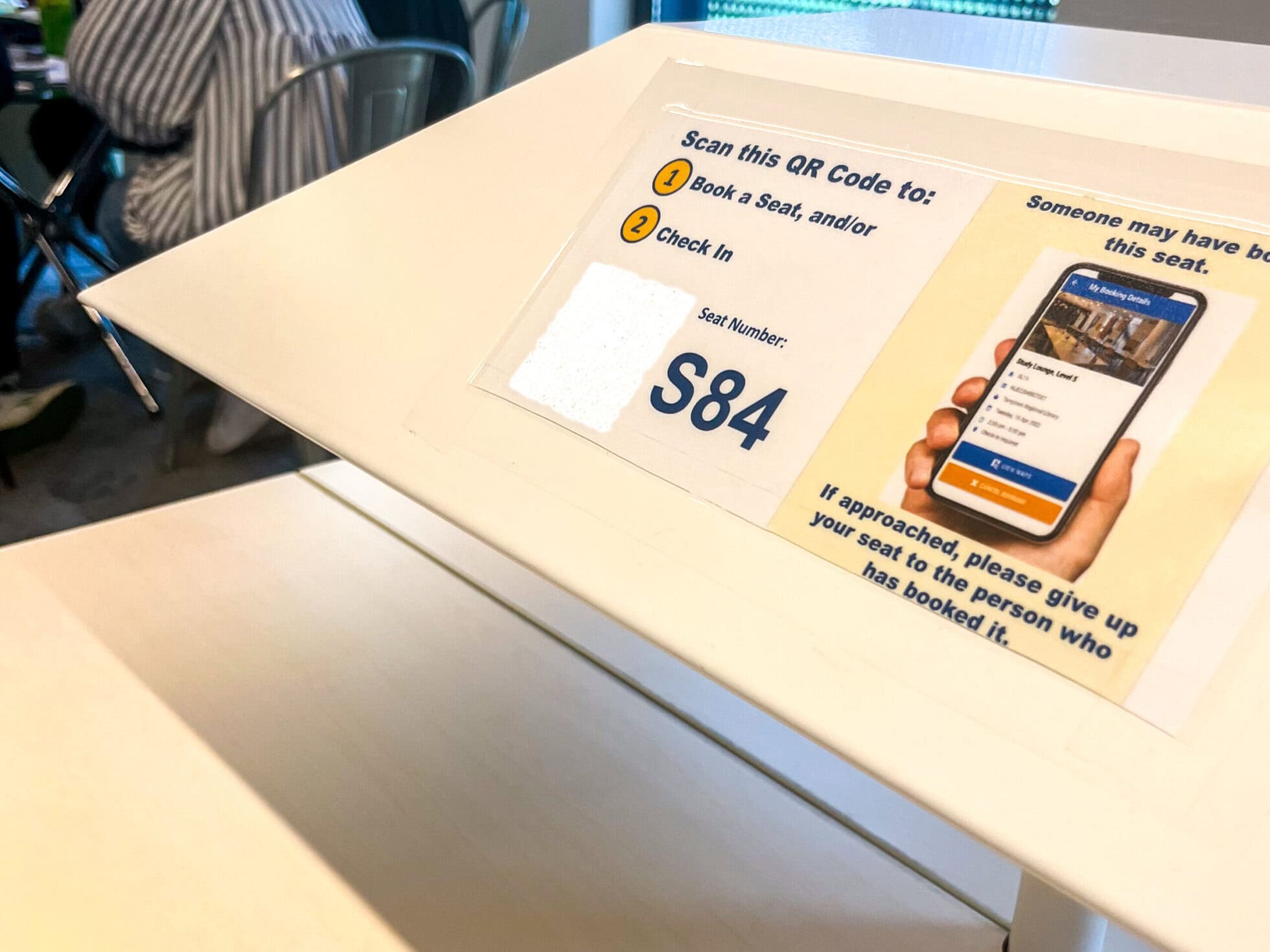
Placed side by side, this is a question of stage, not of which is better. Coworking at 7-Eleven (4 Robinson Road) suits the professional who needs somewhere workable for the next hour, whose task is solitary and unremarkable, and for whom the cost has to stay close to nil. It puts what the city already offers to good use, much as the seat booking arrangement does in our guide to coworking at Singapore's National Library.
A professional workspace suits the business whose work involves clients, colleagues, confidentiality and continuity, and whose reputation has become part of what it sells. Both have their place in the life of a growing firm. The question worth asking is not which is better in the abstract, but which one your business has quietly outgrown.
A Short Checklist Before You Go
- Charge your equipment before leaving, and pack a compact adapter for the sockets fitted beneath the tables.
- Confirm that your mobile hotspot is working, since the national wireless service was not available at this location.
- Avoid the lunch period if you would prefer a quiet table and a short queue at the counter.
- Buy a meal or a hot drink on arrival, keep the receipt, and clear the table before you leave.
- Leave anything confidential closed, and reserve calls for somewhere private.
- Should the second level be open, treat it as an unexpected bonus rather than a part of the plan.
Frequently Asked Questions
Can you work from the 7-Eleven at 4 Robinson Road?
Yes, within limits. The ground floor seating was provided for customers eating in, and it is frequently quiet outside the lunch period, which makes it workable for a short, solitary task. Buy something from the store, occupy one seat, and treat the arrangement as a courtesy rather than a right.
Is there Wireless@SG or free wireless internet at this store?
I found no Wireless@SG coverage at this location, so a personal mobile hotspot is necessary. Confirm that tethering works on your device before you rely on it, and avoid transferring large files over the connection.
Are there power outlets at the seats?
Yes, power outlets are fitted beneath the tables, which allows a laptop to be charged while you work. Look under the table surface when you sit down, and keep any cable clear of the walkway.
What are the opening hours of the 7-Eleven at the House of Eden?
Published hours for this outlet are seven in the morning until eleven at night, daily. Store hours are revised occasionally, so verify before making a special journey, particularly for an early or late visit.
Do I need to buy something in order to sit down?
The seating is intended for customers, so a purchase is the appropriate way to use it. A meal or a hot drink is sufficient, and keeping the receipt removes any awkwardness if you are asked.
May I bring outside food or drink to the tables?
No. Signage at the seating area asks visitors not to bring in outside food and drinks, and requests that alcohol be taken away rather than consumed there. Clearing your table before leaving is expected.
Is the second floor Coca-Cola lounge still open?
The upper level appeared closed on each of our visits, and I have not been able to confirm whether the collaboration has ended permanently. Plan around the ground floor seating and regard the lounge as unavailable unless you find otherwise on the day.
How do I get to the House of Eden at 4 Robinson Road?
Raffles Place station on the Mass Rapid Transit network is the nearest interchange, and Exit F leaves you within a short walk of the shopfront. Several bus stops serve Robinson Road and Raffles Quay, and the store is roughly five minutes on foot from the station concourse.
Is the store suitable for a client call, a video meeting or confidential work?
No. The seating is exposed to foot traffic and street frontage, so screens are visible and conversations are audible to everyone nearby. Sensitive documents and negotiations require closed doors, which is where our serviced offices and meeting rooms become necessary.
How long can I stay, and what should I use for a full working day?
There is no posted limit, but thirty to ninety minutes outside the lunch rush is a reasonable stay for a seat provided to diners. For a full day with privacy, storage, a permanent desk and a professional address, our coworking space offers a dedicated desk in a private shared suite, while our serviced offices provide a complete headquarters without a long lease or a large fit-out. You are welcome to visit us at 6 Raffles Quay, a few minutes away.


0 Comments