
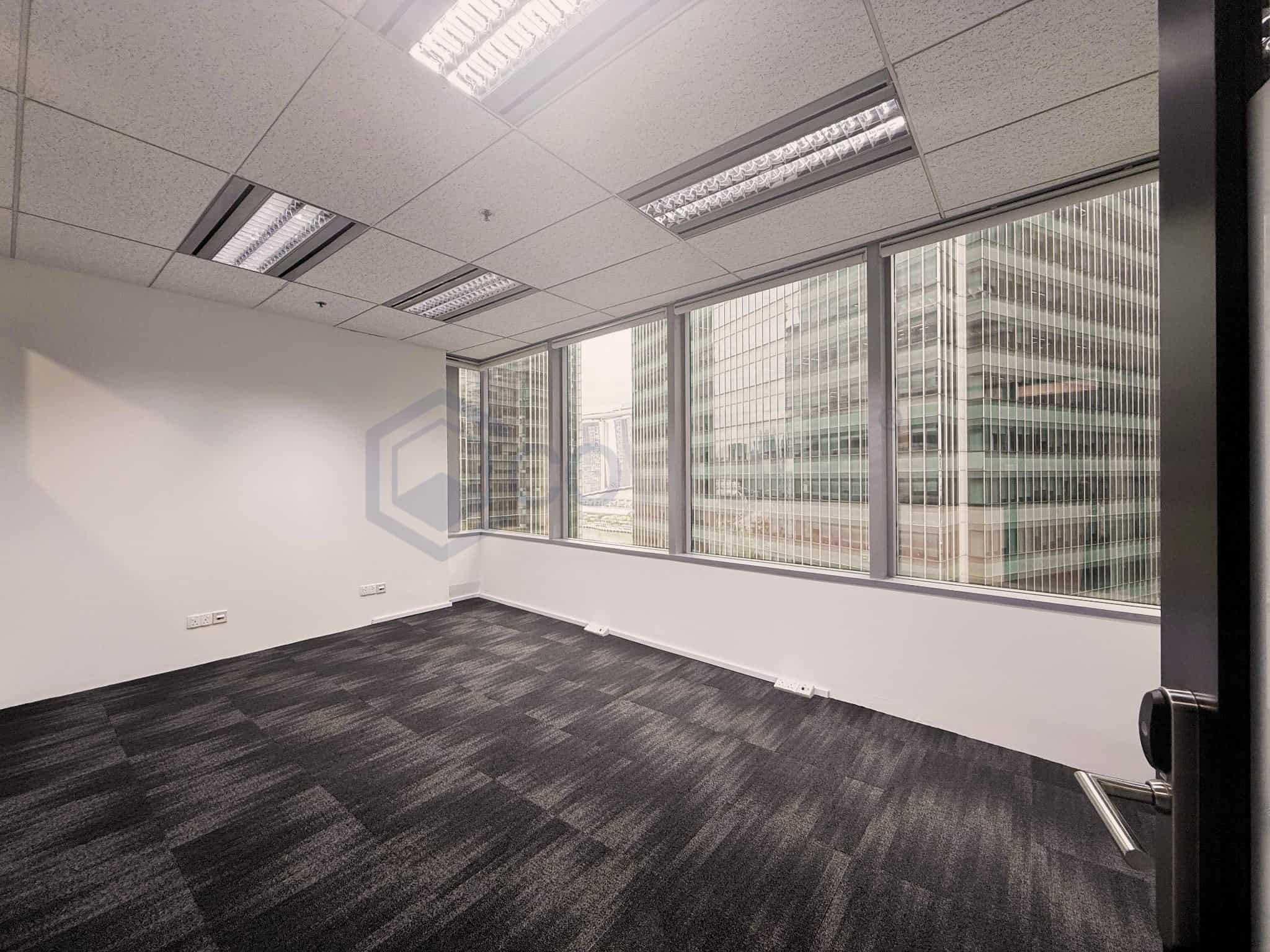
Knowing how to customise our serviced office at 6 raffles quay is becoming one of the more valuable considerations for any managing director who wants the polish of a bespoke headquarters without the financial exposure of a conventional fit-out.
For an established firm in legal services, recruitment, technology, or consultancy, the office is never merely a place to sit.
It is the room where confidential matters are settled, where prospective clients form their first impression, and where a small but capable team finds the stability to do focused work. The difficulty has always been the price of that environment.
Consider the arithmetic that gives so many directors pause.
A traditional fit-out for a modest two thousand square foot unit in Singapore frequently lands somewhere between one hundred thousand and three hundred thousand dollars once partitions, electrical works, flooring, and finishes are accounted for.
Then, at the close of the lease, reinstatement quietly arrives with a further bill, often calculated at tens of dollars per square foot, payable precisely when a business is trying to relocate or downsize.
Committing that kind of capital to a bare-shell unit that a growing team might outgrow within eighteen months is not boldness. It is a wager, and the odds are rarely in the occupier's favour.
How to Customise a Serviced Office Without the Capital Expenditure Burden
The instinct to buy or build a bare shell usually comes from a single belief: that genuine ownership of an environment requires pouring money into the walls. In practice, that belief tends to age poorly. Capital sunk into a fixed fit-out behaves like a holding that cannot be sold, depreciating from the day the contractor leaves and recoverable only as a cost at reinstatement.
A customised serviced office reframes the entire calculation. Rather than financing a renovation, your business directs a far smaller sum toward the elements that actually differentiate it, while the structural shell, the services, and the daily running costs remain the responsibility of the operator. The return on investment improves not because customisation is forbidden, but because the most expensive and least recoverable parts of customisation are removed from your balance sheet. You spend on the pieces that travel with you and signal your identity, and you decline to spend on concrete and ducting that you will only have to undo.
This is the quiet logic that draws directors of small and medium-sized enterprises and multinational branch offices toward the model. The prestige is real, the privacy is real, and the personalisation is real. What disappears is the dread of a six-figure commitment to a space whose future suitability nobody can guarantee.
What Our Serviced Offices Already Provide
Before discussing what you might add, it helps to understand what is already in the room, because a great deal of the customisation that businesses imagine they need has, in fact, been done for them.
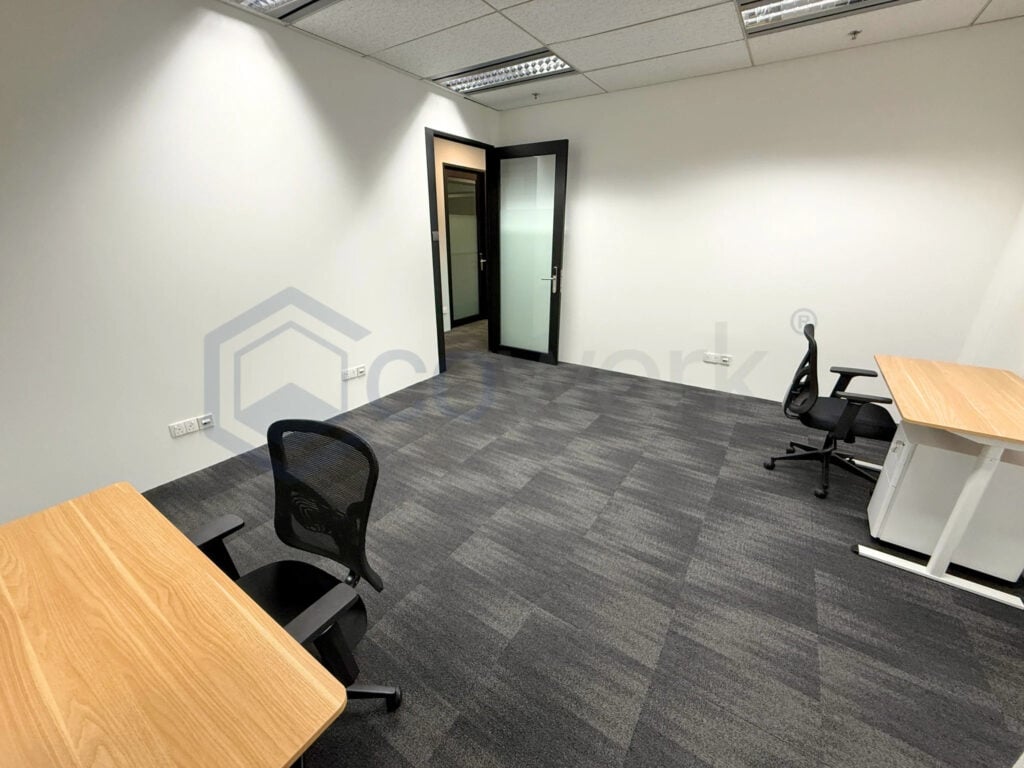
Each of our serviced offices is delivered as a private, lockable suite furnished to a professional standard. Members find ergonomic computer chairs, mobile pedestals for secure personal storage, and electronically height-adjustable desks that move between seated and standing positions at the touch of a control. These are not placeholder furnishings chosen to fill space. They are the working components a professional team relies upon from the first morning, which is why the suite is genuinely plug-and-play rather than plausibly so.
The practical consequence is speed. A director can sign, move in, and have a five to twenty person team productive within days rather than the months a bare-shell project would demand. The environment supports serious work from the outset, which matters because many businesses prefer serviced offices for improved focused productivity over the distractions of an unfinished or shared environment. Customisation, then, begins not from nothing but from a confident baseline, and that distinction changes the nature of every decision that follows.
How to Customise a Serviced Office to Suit Your Team's Workflow
No two professional firms work in quite the same rhythm. A litigation practice guards quiet and confidentiality above almost everything. A recruitment team thrives on movement, conversation, and the constant traffic of candidates. A consultancy oscillates between heads-down analysis and intense collaborative bursts before a deadline. A furnished suite accommodates these patterns more readily than a blank floor, because the foundation is already sound and your adjustments can be precise rather than wholesale.
Within a private suite, members arrange their own desks, meeting points, and quiet corners around the way the team actually behaves rather than around a contractor's assumptions. Specialised equipment finds its place without negotiation: a secure filing cabinet for a legal practice, a dedicated server position for a technology firm, a presentation wall for a consultancy that lives by its decks. Because the suite is private and closed, none of this is on display to a wider floor, and the configuration can shift as the team grows or its methods evolve. The space follows the work, which is the entire point of customisation and the opposite of what a rigid, permanent fit-out delivers.
Loose Furniture and Bespoke Carpentry: Two Routes to a Tailored Suite
When members do wish to go beyond the standard furnishings, two routes tend to satisfy almost every requirement, and they differ chiefly in permanence and intent.
The first route is loose furniture. A business might bring in a particular sofa for a waiting area, a longer boardroom table than the standard provision, or storage and shelving chosen to match a house style. Loose pieces are appealing precisely because they are mobile. They arrive without disruption, they personalise the suite immediately, and they leave with the business when it moves, carrying their value forward rather than surrendering it to a demolition crew.
The second route is bespoke carpentry, and here the craftsmanship can be considerable.
Some members want a desk of a specific length, or cabinetry built to exact dimensions so that it sits flush against the wall and reads as part of the architecture rather than an afterthought.
We have seen businesses commission joinery fitted so precisely to the wall that the finished suite acquires a seamless, almost showroom quality. This is the level of detail that impresses a client the moment the door opens, and it is entirely achievable.
Painting in a brand colour or a more considered palette is possible in the same spirit. The single condition attached to work of this kind is addressed plainly further down, and it is the one detail a prudent director will want to settle before commissioning anything permanent.
Partitions, Structural Changes, and Regulatory Approval
There is a boundary worth naming clearly, because it is the one place where enthusiasm can outrun good sense.
Erecting new partitions, or hacking and altering existing ones, falls into a different category from furniture and joinery. Such structural work is subject to approval by the Singapore Civil Defence Force, since partitions affect fire safety, escape routes, and the integrity of the building's systems. The approval process exists for sound reasons, and it is not a formality to be wished away. For that reason we do not normally recommend partition works to members, and we tend to guide directors toward the many ways of achieving privacy, branding, and a distinct identity that do not involve moving a wall.
In the overwhelming majority of cases, this is no constraint at all. The privacy a deal requires is already supplied by the closed door of a private suite. The separation a team wants between functions can be created with freestanding elements, considered furniture placement, and acoustic treatment rather than masonry. Approaching customisation this way keeps a project simple, lawful, and reversible, which is exactly the posture a director who values stability ought to favour.
Customising for Security, Privacy, and Compliance
For firms in finance, law, or any regulated field, the office is partly an instrument of compliance, and customisation can reinforce that function without structural upheaval.
A private, lockable suite is itself the foundation of confidentiality, but members frequently add to it. Safes and lockable cabinets protect sensitive documents and physical valuables. Privacy screens and considered positioning keep client matters away from passing eyes. Storage can be specified to suit the record-keeping obligations a particular practice carries. The aim throughout is a room that quietly satisfies the expectations of clients and regulators alike, so that a partner can host a sensitive conversation and a counterparty can sense, rather than be told, that the matter is in careful hands. Confidence of this sort is rarely announced. It is felt, and a well-customised suite is one of the more reliable ways to produce that feeling.
Customising to Strengthen Your Brand and Prestige
An office is among the most persuasive marketing instruments a professional firm possesses, and not a word of it is spoken aloud. A prospective client who steps into a thoughtfully composed suite at a prestigious address has already begun to form a judgement before the meeting starts.
This is where customisation earns its keep. A considered palette, a piece of artwork, signage that carries the firm's name with quiet authority, and furnishings selected to reflect the company's character together turn a competent room into a memorable one. The setting amplifies the message.
Our suites occupy a respected building at Raffles Quay, and that location does a great deal of the work before any furniture is chosen, lending immediate credibility to a younger firm and reassurance to an established one. The customisation a business layers on top personalises that prestige, so that the address signals standing and the interior signals identity. For firms drawn to the character of nearby Tanjong Pagar, our serviced office suites near Tanjong Pagar are a blank canvas to bring some of that personality indoors, with the financial-core address intact.
The combined effect on morale within the team is worth noting too, since people tend to take pride in a space that feels unmistakably their own.
Premium Amenities That Support Every Customised Suite
Whatever a business chooses to add to its own suite, it continues to draw on the shared infrastructure that makes the serviced model so undemanding to run. This is where the second great frustration of the traditional office, the administrative fatigue of managing utilities, cleaners, and connectivity, simply dissolves.
High-speed business internet is provided and maintained, removing one of the more tedious set-up tasks entirely.
Professionally appointed meeting rooms and seminar spaces are available when a suite alone will not do, so a firm can host a board session or a client pitch without owning the square footage year-round. On-hand information technology support means a connectivity issue is somebody else's responsibility to resolve, not a partner's morning.
Secure mail handling, cleaning, and the running of the building proceed without a director ever scheduling them. And the whole operation sits in the heart of the Central Business District, within easy reach of clients, banks, and government offices.
For an executive who regards administration as non-revenue-generating activity, this is the quiet dividend of the model: the personalised suite feels like yours, while the work nobody wants to do belongs to somebody else.
How Customisation Supports Scalability, Agility, and Stability
The deeper appeal of a customised serviced office is strategic, and it speaks directly to the fear of being trapped.
A conventional three-year lease assumes a future that few directors can honestly predict.
Headcount in professional services moves with the market, and a commitment signed in a confident quarter can become a liability in a cautious one. The serviced model restores agility. A business can scale its suite as the team grows, or contract it when prudence calls for restraint, without the penalty of stranded capital in a fixed fit-out. Scalability stops being a slogan and becomes an operational reality.
That flexibility, somewhat counterintuitively, produces stability rather than undermining it. A firm that is not over-committed to space it may not need is a firm that can absorb a difficult quarter, seize an unexpected opportunity, or change direction without first untangling itself from a costly lease.
Customisation built on loose furniture and removable joinery rather than permanent construction keeps the whole arrangement light enough to adjust. The return on investment, properly understood, is not only the money saved on a fit-out. It is the freedom to make the right decision later, unencumbered by the wrong one made earlier.
The One Condition: Restoration at the Member's Own Cost
Customisation of any permanence comes with a single, straightforward condition, and it is far gentler than the equivalent in a traditional lease. Whatever a business introduces, whether bespoke carpentry, painting, or other lasting alterations, the suite must be restored to its original condition at the end of the term, at the member's own cost.
This is reasonable, and it is worth weighing at the outset rather than at the close. A director who anticipates it can make calmer choices. Loose furniture, which simply departs with the business, avoids restoration almost entirely and is often the wiser option for that reason alone. Where bespoke joinery genuinely serves the brand, the cost of eventually removing it can be planned for as a known, modest figure rather than discovered as an unwelcome surprise. Compared with the reinstatement of a fully built-out conventional office, which can be a substantial undertaking, the obligation here is small and predictable. Settling it in advance is simply good housekeeping, and it allows a business to customise with confidence rather than caution.
How to Customise a Serviced Office Versus Our Coworking Space
It is worth distinguishing the private suite from the alternative we offer, since the right answer depends on a firm's stage and temperament.
Our coworking space is a shared suite containing several dedicated desks, up to three, rather than open-plan seating. Each desk belongs to a specific person, which preserves a degree of permanence and quiet that an open floor cannot, while the shared nature keeps the commitment and the cost modest. It suits a sole director, a two-person founding team, or a satellite presence testing a new market before committing to a full suite. Customisation in this setting is necessarily lighter, centred on personal effects and equipment rather than carpentry or paint, because the room is shared.
A private serviced office is the natural choice for a firm that needs closed doors for confidential work, the freedom to brand and configure a room as its own, and the standing that a dedicated headquarters confers. Most established small and medium-sized enterprises and branch offices in professional services arrive at the private suite for precisely these reasons. The two options are not rivals so much as points on a single path, and a business can begin in our coworking space and graduate to a private suite as it grows, without ever leaving the building or the address it has come to rely upon.
Is a Customised Serviced Office Right for Your Business?
If your firm values privacy for sensitive conversations, a prestigious address that does quiet work on your behalf, and the agility to adjust as conditions change, then a customised serviced office deserves serious consideration. It delivers the identity and security of a bespoke headquarters while sparing your business the capital risk, the administrative drudgery, and the lease rigidity that make the traditional route so unforgiving.
The most sensible next step is to see a suite in person and discuss exactly what your firm would add to it.
Contact us to arrange a tour of our serviced offices at 6 Raffles Quay, and discover how readily a furnished, connected suite can be made unmistakably your own in the heart of Singapore's Central Business District.
Frequently Asked Questions
Can you customise a serviced office?
Yes. Our serviced offices arrive fully furnished, and members may personalise them further with loose furniture, bespoke carpentry, branding, and paint. The only structural exception is partition work, which requires regulatory approval and is not normally recommended.
How do you customise a serviced office without renovating?
Most personalisation is achieved with loose furniture, freestanding storage, signage, artwork, and considered layout, none of which involves construction. This approach delivers a distinct identity while keeping the arrangement reversible and your capital protected.
What furniture comes with a serviced office?
Each suite is provided with ergonomic computer chairs, mobile pedestals for secure storage, and electronically height-adjustable desks. The result is a professional, plug-and-play environment that a team can occupy and work in from the first day.
Can I bring my own furniture into a serviced office?
Yes. Many members introduce their own loose furniture, such as a preferred boardroom table, sofa, or shelving. Loose pieces personalise the suite immediately and leave with the business at the end of the term, avoiding restoration costs.
Can I build partitions in a serviced office in Singapore?
Partition works and structural alterations are subject to approval by the Singapore Civil Defence Force because they affect fire safety. For that reason we do not normally recommend them and instead suggest privacy solutions that require no construction.
Do I have to restore a customised serviced office at the end of the membership period?
Yes. Any lasting customisation, such as bespoke carpentry or painting, must be restored to the suite's original condition at the member's own cost. Loose furniture avoids this almost entirely, since it simply departs with your business.
Is a serviced office cheaper than a conventional office fit-out?
In most cases, yes. A traditional fit-out for a small office can run well into six figures, with reinstatement added later. A customised serviced office removes the structural spend and improves the return on investment considerably.
How quickly can I move into a serviced office?
Because the suite is furnished and connected on arrival, a team can typically sign and occupy within days rather than the months a bare-shell renovation requires. This speed is one of the principal advantages of the model.
Can I brand a serviced office with my company identity?
Yes. Members may add signage, a considered colour palette, artwork, and furnishings that reflect the firm's character. Combined with a prestigious Raffles Quay address, this allows a business to project both standing and a distinct identity.
What is the difference between a serviced office and a coworking space?
A serviced office is a private, lockable suite for a single business. Our coworking space is a shared suite with several dedicated desks, up to three, rather than open-plan seating, making it a lighter and more affordable option for very small or satellite teams.



Customisable bare units sound like a great idea for businesses wanting flexibility. I’ve been looking for options that allow us to set up our office just right.
I’d be curious about how much these bare units actually cost compared to traditional leases. Anyone has insights?
It’s refreshing to see a focus on personalisation in office spaces. It really makes a difference to work in a space that feels like your own.
How does CoWorkSpace ensure security for sensitive information in these units? That’s a big concern for many businesses.
I love the idea of being able to integrate our own equipment. It really helps in creating a more efficient workspace.
Are there any examples of businesses that successfully transformed their bare units? I’d love to see some inspiration!
I appreciate the emphasis on brand identity. A well-designed office can truly reflect a company’s culture.
While the concept is appealing, I wonder if the upkeep of a bare unit would become a hassle over time. Thoughts?
These bare units might be perfect for freelancers or small teams. It gives the freedom to create a unique working environment.
Not sure if this is for me. Sounds like a lot of effort to set everything up just right.